


For the last few years, there was almost no decision to make about that money. It was sitting inside a fixed deposit, earning interest and waiting for its maturity date. Then the FD matures.
Suddenly, ₹5 lakh, ₹10 lakh, ₹20 lakh or perhaps a much larger amount is available again, and the questions begin:
- Should I renew the FD?
- Should I invest the money somewhere else?
- Should I use some of it to repay a loan?
- Should I keep it in the bank for now?
- Should I move it into mutual funds?
These are all valid questions. But there is one question that should come before all of them: What does this money actually need to do for you?
An FD maturity is not automatically an investment decision. It is an opportunity to look at your current financial situation again and decide what role that money should now play.
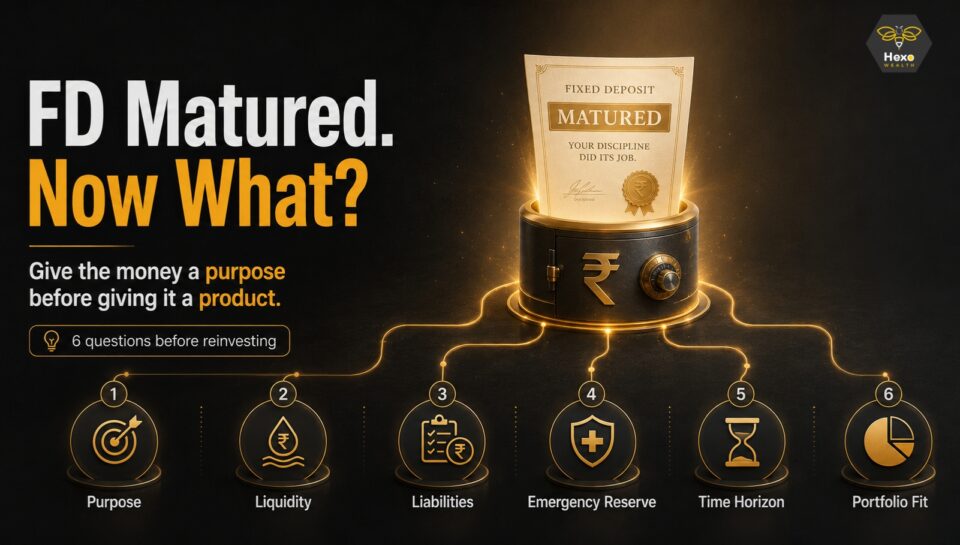
Before giving the money another product, it helps to first give the money a purpose.
What Happens When an FD Matures?
When a fixed deposit reaches maturity, the maturity proceeds generally become available according to the instructions selected with the bank. Depending on those instructions, the deposit may be renewed or the maturity amount may become available in the linked account.
That is the operational part. The more important financial question begins after that. Just because the money was previously in an FD does not mean it automatically needs to go back into another FD. At the same time, maturity does not mean the money must now be moved into a market-linked investment.
The previous investment has ended. The next decision should depend on what your life and finances look like today.
The First Decision Is Not Where to Invest
One of the easiest mistakes after an FD matures is to start comparing products immediately.
- Which FD is offering a better rate?
- Which investment could earn more?
- Should I move the money into equity?
- Should I invest the entire amount at once?
The problem with starting here is that an investment product is being selected before the purpose of the money has been decided.
Consider two amounts of ₹10 lakh. One ₹10 lakh may be required for a child’s education 2 years from now. Another ₹10 lakh may not be required for the next 15 years.
The amount is exactly the same. But the job of the money is completely different. The investment decision should therefore begin with the purpose and time horizon, not only with the amount available.
The Hexo FD Maturity Reset: 6 Questions to Ask Before Reinvesting
Before deciding what to do with an FD maturity amount, we believe it helps to pause and answer 6 simple questions. These questions can often provide more clarity than immediately comparing investment products.
1. What Does This Money Need to Do?
Start with the most basic question: why do you have this money?
Perhaps the original FD was created for a specific purpose. Maybe that purpose still exists, or perhaps your circumstances have changed completely since the deposit was created.
The money could now be intended for:
- A child’s education
- Retirement requirements
- A future home purchase
- A family responsibility
- Regular income needs
- A business requirement
- A major expense a few years from now
- Long-term wealth creation
- Simply maintaining financial security
Sometimes there may be no clearly defined purpose yet. That is also useful to recognise. When money has no defined job, people often make investment decisions based on whichever product, return or opportunity looks attractive at that moment.
Giving the money a purpose first helps reduce that tendency.
2. Will You Need Any Part of This Money Soon?
Not all of the maturity amount necessarily has the same time horizon.
Suppose an FD of ₹15 lakh matures.
You may already know that ₹4 lakh will be required next year for a family commitment. Another ₹3 lakh may need to remain accessible as a financial reserve. The remaining amount may not be required for many years.
Treating the entire ₹15 lakh as one investment decision would ignore these different requirements.
Before investing, identify whether any portion of the money could be needed in:
- The next few months
- One to two years
- Five to seven years
- Ten years or more
The closer the financial requirement, the more important liquidity and stability generally become.
Money required for a known near-term expense should not automatically be treated in the same way as money intended for a long-term goal.
3. Are There Existing Liabilities Worth Reviewing?
An FD maturity can also be a good time to look at the liability side of your finances.
Perhaps you have:
- A home loan
- A personal loan
- A vehicle loan
- Credit-card debt
- Another significant financial liability
This does not mean every loan should automatically be repaid whenever an FD matures. The decision requires a broader look at factors such as:
- The cost of the liability
- Remaining loan tenure
- Prepayment conditions
- Available liquidity after repayment
- Tax considerations where applicable
- Other financial goals
- What you would otherwise do with the money
The important point is simply this: Do not look only at where the maturity money can be invested. Also look at whether something on the other side of your balance sheet deserves attention.
Sometimes improving the liability side of your finances can be just as important as finding the next investment.
4. Is Your Emergency Reserve Strong Enough?
Before committing the entire FD maturity amount elsewhere, check whether you already have enough accessible money for unexpected situations. An emergency reserve may be required for events such as:
- Temporary loss of income
- Medical costs not fully covered by insurance
- Essential repairs
- Family emergencies
- Unexpected compulsory expenses
Someone with ₹20 lakh available after an FD maturity may feel financially comfortable. But if almost all other money is locked into long-term assets and there is very little accessible cash, investing the entire maturity amount again could leave the household financially inflexible.
Your emergency reserve and your long-term investments perform different jobs.
Make sure the first job is already reasonably covered before assigning every rupee to the second.
5. What Is the Real Time Horizon for This Money?
Time horizon is one of the most important questions in any investment decision.
Ask yourself: When could I realistically need this money?
Not when you would ideally like to keep it invested.
When you may actually need it.
A useful way to think about the money is through different periods.
Shorter-Term Requirement
This may include money required within the next one or two years.
The priority here may be availability and stability rather than taking significant investment risk in search of higher returns.
Medium-Term Requirement
This could involve a goal several years away.
There may be more flexibility, but the investment still needs to reflect how important the goal is and how much uncertainty you can reasonably accept.
Longer-Term Requirement
Money genuinely not required for many years gives you more time to consider a wider range of investment choices based on your goals, risk profile and overall asset allocation.
But a long investment horizon alone does not automatically make one particular investment suitable.
Your risk capacity, existing portfolio and financial responsibilities still matter.
Thinking in terms of what the money needs to do and how long it can genuinely remain invested can make the next decision much clearer.
6. What Does the Rest of Your Portfolio Already Look Like?
This is one question that is easy to miss. An FD maturity amount should not always be evaluated in isolation. Suppose your existing financial assets are already heavily concentrated in one type of investment. Adding the entire maturity amount to the same area may increase that concentration further.
In another situation, the maturity amount might help bring better balance between:
- Accessible money
- Fixed-income assets
- Market-linked investments
- Short-term requirements
- Long-term goals
The right question is therefore not only: Where should this ₹10 lakh go?
It is also: Where does this ₹10 lakh fit into everything I already have?
This is why looking at your overall financial picture is more useful than evaluating one matured FD separately.
Same ₹10 Lakh FD Maturity. Three Completely Different Situations.
Let us take a simple example:
Three people each receive ₹10 lakh from an FD maturity. The amount is identical. But their situations are completely different.
Situation A: One Income, Large EMI and Limited Emergency Savings:
The first person is the only earning member of the household. There is a sizeable home-loan EMI, children are financially dependent, and the family’s accessible emergency savings are limited.
For this person, immediately investing the entire ₹10 lakh for long-term growth may not be the first priority.
Part of the money may need to strengthen financial liquidity or the person may need to evaluate existing liabilities before deciding what can genuinely remain invested for the long term.
Situation B: A Major Goal Is Two Years Away:
The second person has adequate emergency savings and controlled liabilities. However, ₹6 lakh from the maturity amount may be required for a known family goal within the next two years.
That changes the role of the money.
The investment decision for the ₹6 lakh cannot be based on the same horizon as the remaining ₹4 lakh.
Situation C: No Major Liability and a Long Time Horizon:
The third person has adequate emergency reserves, controlled liabilities and no requirement for the maturity amount for another twelve to fifteen years.
This person can evaluate the money from a longer-term perspective while considering the existing portfolio, risk profile and financial goals.
The lesson is simple.
The same ₹10 lakh does not automatically deserve the same investment.
Amount alone cannot determine allocation. Purpose, time and financial circumstances matter.
Should You Simply Renew the FD?
Sometimes renewing the FD may still make sense. Sometimes it may not. There is nothing inherently wrong with renewing a fixed deposit merely because it has matured. The mistake is renewing it automatically without checking whether the purpose of the money has changed.
Before renewing, ask:
- Why do I need this money?
- When will I need it?
- How much liquidity do I require?
- How much investment risk am I comfortable taking?
- What does my existing portfolio already contain?
- Are there liabilities or financial goals that need greater attention?
If the purpose, horizon and risk requirements continue to match an FD, renewal may remain one of the options to evaluate. If they do not, the maturity date gives you an opportunity to reconsider the allocation.
The objective is not to move out of an FD simply because another investment appears to offer a higher potential return. The objective is to choose something that fits the job the money needs to perform.
What If the FD Belongs to Your Parents or a Retired Family Member?
This requires extra care.
Children sometimes look at a parent’s matured FD and think: This money will not be required immediately, so perhaps it should be invested for higher growth.
But the parent’s financial situation may be very different from the child’s.
A retired person may:
- No longer receive a regular salary
- Depend on investments for monthly expenses
- Need greater access to money
- Have recurring healthcare costs
- Have a lower ability to recover financially from a large loss
- Value stability differently from a younger earning family member
This means the child’s investment horizon and risk appetite should not automatically be applied to the parent’s money. Even when the maturity amount appears large, first understand what role that money plays in the parent’s overall financial security.
The ownership of the money matters. The person’s life stage matters. Their dependence on that money matters.
What If the Entire FD Amount Does Not Have One Purpose?
It does not need to.
A common assumption is that because ₹20 lakh matured from one FD, the entire ₹20 lakh must now go into one new investment.
That is not necessary. The money may have several different jobs. For example, one portion may need to remain accessible for emergencies. Another portion may be required for a known medium-term expense. A third portion may genuinely have a long investment horizon.
Instead of asking: Which one investment should I choose for the entire amount?
It may be more useful to ask: How many different jobs does this money need to perform?
Once those jobs are identified, allocation becomes much easier to think about.
Common Mistakes After an FD Matures:
1) Automatically Renewing It Without Reviewing Your Situation:
What was appropriate three or five years ago may not automatically remain appropriate today.
Your income, family responsibilities, liabilities and goals may have changed.
2) Moving the Money Only Because Another Investment Shows Higher Returns:
Higher potential return usually comes with different risks.
Return should therefore never be evaluated without understanding risk, liquidity and time horizon.
3) Choosing an Investment Before Deciding When the Money Is Required:
A product may look attractive until you realise the money is required much earlier than the investment horizon allows.
Purpose and timeline should come first.
4) Ignoring Existing Liabilities:
The asset side of your financial life should not be reviewed without looking at the liability side.
5) Looking at the Matured FD Separately From Everything Else:
The maturity amount becomes part of your overall financial assets.
It should therefore be considered alongside your existing investments rather than treated as an isolated pool of money.
6) Using Your Risk Appetite for Your Parent’s Money:
A younger earning person’s ability to tolerate market fluctuations may be very different from that of a retired parent.
Investment decisions should reflect the financial situation of the actual owner of the money.
7) Feeling That the Money Must Be Invested Immediately Because It Is “Idle”:
This is an important one.
When a large maturity amount reaches the bank account, people often become uncomfortable seeing it sitting there.
They feel that every day without investing it means losing an opportunity.
That feeling can create unnecessary urgency.
There is a difference between leaving money directionless for months and taking a reasonable amount of time to make the right decision.
A few days spent understanding the purpose of the money may be more valuable than rushing into a multi-year investment simply because the amount feels idle.
A Simple Checklist Before Reinvesting Your FD Maturity Amount
Before taking the next step, ask yourself:
1. Purpose:
What financial goal or responsibility is this money meant for?
2. Liquidity:
Could any part of the money be required unexpectedly or in the near future?
3. Liability:
Is there any existing loan or debt that deserves evaluation?
4. Emergency Reserve:
Do I already have enough accessible money for unexpected situations?
5. Time Horizon:
When might I realistically need this money?
6. Existing Portfolio:
How will this amount affect my overall asset allocation?
7. Life Stage:
Does my age, income pattern, retirement status or family responsibility change how this money should be treated?
If you cannot clearly answer these questions, comparing investment products may be premature.
Frequently Asked Questions
1) What Should I Do After My FD Matures?
First identify why you need the money, when you may need it, whether you have adequate emergency liquidity, whether liabilities require attention and how the maturity amount fits into your existing portfolio. Only after this should you evaluate suitable investment options.
2) Should I Renew My FD After Maturity?
Renewal may be appropriate in some situations, but it should not happen automatically. Consider the purpose of the money, time horizon, liquidity requirement, risk profile and current financial situation before deciding.
3) Can FD Maturity Money Be Invested in Mutual Funds?
Mutual funds may be considered depending on the investor’s goals, risk profile, investment horizon and financial circumstances. Mutual funds are market-linked investments and are not suitable for every purpose or every investor.
4) Should I Repay My Home Loan Using FD Maturity Money?
There is no universal answer. Consider factors such as the loan cost, remaining tenure, prepayment conditions, available liquidity, taxation, other financial goals and what you would otherwise do with the maturity amount before deciding.
5) What Should Senior Citizens Consider After FD Maturity?
Senior citizens should particularly consider regular income requirements, liquidity, healthcare needs, existing assets, liabilities, risk capacity and dependence on the maturity corpus before changing the allocation.
6) Can I Divide the FD Maturity Amount Into Different Investments?
Yes. Different portions of the money may have different purposes and time horizons. The allocation should reflect those different requirements rather than assuming the entire maturity amount needs one investment.
7) Is It Okay to Keep the FD Maturity Amount Temporarily in a Bank Account?
Taking reasonable time to assess your financial situation before reinvesting can be more sensible than making an immediate decision only because the money has become available. However, the amount should not remain directionless indefinitely.
Final Thought: Give the Money a Purpose Before Giving It a Product
An FD maturity is more than the end of a deposit. It is a point at which the money becomes available for a fresh decision.
And the most important decision is not necessarily: Where should I invest it next?
Start with: What does this money need to do for me?
Once the purpose, liquidity requirement, liabilities, time horizon and existing portfolio are clear, the investment conversation becomes much more meaningful.
- Sometimes the right decision may involve renewing an FD.
- Sometimes it may involve keeping a portion accessible.
- Sometimes a liability may deserve consideration.
- Sometimes different parts of the money may need different investment approaches.
There is no need for every maturity amount to receive the same answer. The better approach is to first understand the role of the money and then find an allocation that supports that role.
Planning the Next Step for Your Mutual Fund Investments?
If part of your FD maturity amount is genuinely available for longer-term goals, the next step is to evaluate that money in the context of your goals, risk profile, time horizon and existing investments.
Connect with Hexo Wealth, an AMFI-registered Mutual Fund Distributor in Hiranandani Estate, Thane, to understand the mutual fund investment process.
ARN: 353817
Disclaimer:
This article is intended solely for investor education and general information. It should not be treated as investment advice, tax advice, loan-repayment advice or as a recommendation to invest in any particular mutual fund scheme, security or financial product. Individual financial decisions depend on factors including goals, risk profile, investment horizon, liquidity requirements, liabilities and personal financial circumstances.
Any examples used in this article are hypothetical and are provided only for explaining the concepts discussed.
Mutual Fund investments are subject to market risks, read all scheme related documents carefully.