


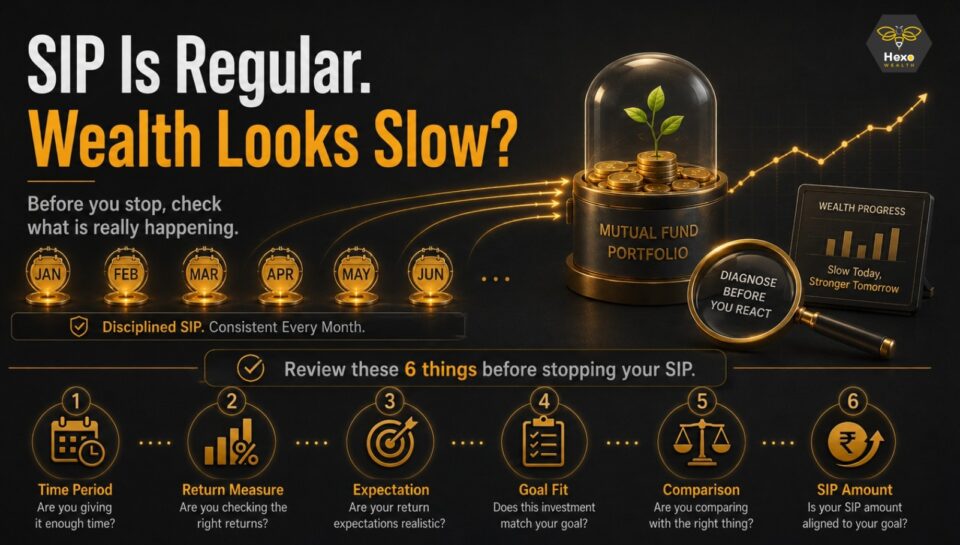
You have been investing every month without missing your SIP. The amount is deducted from your bank account on time, units keep getting added, and you have stayed disciplined even when the market has been uncertain. Yet, when you open the investment app, the portfolio does not look very different from the total amount you have invested. The gain appears small. At times, the value may even fall below the amount invested.
That is when the doubt begins: “I have been investing regularly. Why is my SIP not giving returns?”
Some investors immediately assume that the mutual fund is wrong. Others start looking at recently better-performing funds. A few stop the SIP because they feel that their money is not growing fast enough. But a slow-looking portfolio does not automatically mean that the SIP has failed. At the same time, simply telling every investor to “continue and be patient” is also not a complete answer. Before stopping, switching or increasing an SIP, you need to identify the actual reason behind the disappointing experience.
It could be the investment period. It could be the market phase. It could be the way you are measuring returns. It could be an unrealistic expectation. It could be an unsuitable investment. Or the SIP amount itself may be too small for the goal you are expecting it to achieve.
The first step is not to react. The first step is to diagnose.
SIP Returns Look Low. Does That Mean Something Is Wrong?
Not necessarily. Mutual funds are market-linked investments, so their value can move up and down. A portfolio may show weak, flat or negative returns over shorter periods even when the investor is investing regularly. This is particularly important for someone who started an SIP only two or three years ago.
A short investment period may not be enough to judge a long-term investment process. Most of the instalments in a recent SIP have also not been invested for the full two or three years. However, low returns should not be ignored blindly either. The underlying mutual fund must still remain suitable for your:
- Financial goal
- Risk profile
- Investment horizon
- Overall asset allocation
- Current financial situation
The right response is therefore not always “stop”, and it is not always “continue”. The right response is: Understand why the portfolio looks slow before deciding what to do next.
First Understand What an SIP Actually Is
An SIP, or Systematic Investment Plan, is a method of investing a fixed amount regularly in a mutual fund. It is not a separate investment product. When you start an SIP, your money is being invested in an underlying mutual fund scheme. The return will depend on the type of fund, the securities it holds, market conditions, expenses and how long your money remains invested.
The SIP Does Not Decide the Return
Two investors may both invest through SIPs and still receive very different outcomes. One may be investing in an equity-oriented fund for a long-term goal. Another may be investing in a different category for a shorter requirement. The SIP only creates a regular investment process. It does not make every underlying mutual fund equally suitable, nor does it make returns fixed or guaranteed.
Every Instalment Has a Different Investment Period
This is one of the most important things to understand.
Suppose you have been investing ₹5,000 every month for 3 years. Your first instalment has been invested for around 3 years. But the instalment invested last month has been in the market for only one month. The instalment before that has been invested for only two months.
So although you may say, “I have been doing this SIP for three years,” your complete investment has not received three years to grow. Every monthly contribution has a different starting date and a different investment period. This is why the early years of an SIP may look slower than many investors expect.
Why Your Wealth May Look Slow in the Initial Years
Several factors can make an SIP portfolio appear disappointing even when the investor has been disciplined.
1) Your Invested Capital Is Still Being Built:
In the early years, the main contribution to the portfolio is usually coming from the money you are adding every month. For example, a monthly SIP of ₹5,000 over three years means a total contribution of ₹1.80 lakh. Even if the investment generates a reasonable percentage return, the absolute rupee gain may not look large because the invested base itself is still modest.
This creates an important difference between 2 questions:
- Has the investment generated a reasonable return?
- Has the portfolio become large enough to create substantial wealth?
These are not the same question. A reasonable return on a small investment base can still produce a small rupee gain.
2) The Market Phase May Be Affecting Recent Returns:
Investment returns do not arrive evenly every month or every year. There can be periods when the market rises strongly, periods when it remains almost flat and periods when it declines. An investor who begins during or just before a muted market phase may not see exciting returns in the first few years. This does not automatically prove that the underlying investment is good or bad. It simply means the market environment must be considered before judging the result.
3) Your Most Recent SIP Instalments Are Still New:
When an investor increases the SIP or adds a significant amount recently, the portfolio’s overall return may look lower because a large portion of the capital has not been invested for very long. This is particularly relevant while reading XIRR, which takes the date and amount of every cash flow into account.
4) Return Percentage and Portfolio Size Are Different:
An investor may receive a reasonable percentage return but still feel disappointed because the portfolio value has not become very large. Portfolio size depends on more than return. It is influenced by:
- The amount invested
- How long the money remains invested
- The investment outcome
- Whether contributions increase over time
- Whether withdrawals interrupt the process
If the SIP amount remains small, the final portfolio may also remain smaller than expected, even when the investment itself has not performed unusually poorly.
The Hexo SIP Progress Check: 6 Questions Before You Stop
Before deciding that your SIP is not working, go through these 6 checks.
1. How Long Has the SIP Actually Been Running?
Start with the investment period.
A two-year SIP should not be evaluated as if it has already completed a ten or fifteen-year journey.
Ask:
- When did I start investing?
- What is the actual time horizon of my goal?
- Has enough time passed to judge the chosen mutual fund category?
- Have I made large recent additions that are affecting the return calculation?
There is no single compulsory holding period that applies to every mutual fund. The appropriate period depends on the nature of the underlying investment and the goal for which it was selected. But if the original goal is many years away, judging the process only through a recent return window may lead to an emotional decision.
2. What Return Number Are You Looking At?
Investment apps may show several different numbers:
- Amount invested
- Current value
- Absolute gain
- Absolute return
- Annualised return
- XIRR
- Scheme return
- Complete portfolio return
These numbers answer different questions.
a) Absolute Return:
Absolute return shows the percentage change between the amount invested and the current value. It does not fully account for the different dates on which SIP instalments were invested.
b) XIRR:
XIRR considers both the amount and the timing of each investment and withdrawal.
Because every SIP instalment is invested on a different date, XIRR is generally more useful for understanding the annualised return of multiple cash flows.
However, even XIRR should not be viewed in isolation.
A return figure needs context:
- How long has the investment been running?
- What type of mutual fund is it?
- What happened in that category during the same period?
- Is the investment suitable for the goal?
- Were major additions or withdrawals made recently?
Reading one percentage without this context can create the wrong conclusion.
3. What Were You Expecting by This Stage?
Many investors begin an SIP with an assumed return already fixed in their minds.
That expectation may come from:
- A calculator using an assumed rate
- A social-media post
- A friend’s portfolio
- A recent strong market period
- A past-return chart
- A discussion about reaching ₹1 crore
But projections are not promises. A calculator may help illustrate how regular investing could work under a stated assumption. It cannot tell you what the market will deliver every year.
Before calling your SIP disappointing, ask:
- What outcome was I expecting?
- Where did that expectation come from?
- Was it realistic for this investment period?
- Was I expecting long-term wealth to become visible within two or three years?
Sometimes the investment may not be failing. The expectation may have been set incorrectly.
4. Does the Underlying Investment Still Fit the Goal?
Consistency is useful only when the investment remains suitable.
Ask:
- Why was this mutual fund selected?
- What goal is it meant to support?
- When will the money be required?
- Does its risk level match my ability to handle fluctuations?
- Does it fit with the rest of my portfolio?
- Has my financial situation changed since I started?
An SIP chosen only because the fund had delivered strong recent returns may not have been the right selection in the first place. Similarly, a mutual fund suitable for a long-term goal may be inappropriate for money required within a short period. The SIP method may be regular, but the underlying investment still needs to perform the right job.
5. Are You Making the Right Comparison?
Investors frequently compare investments that are doing completely different jobs.
For example:
- Comparing a short-period equity SIP with an FD
- Comparing a diversified fund with a recently successful sector fund
- Comparing your full portfolio with a friend’s one winning stock
- Comparing one mutual fund category with another category carrying very different risk
- Comparing today’s outcome with a calculator projection
These comparisons may create dissatisfaction without providing useful information.
Where performance is reviewed, it should be compared with:
- An appropriate benchmark
- A relevant peer category
- A suitable time period
- The original goal and risk profile
The purpose of comparison should be to understand whether the investment is doing its intended job, not to find whichever product performed best recently.
6. Has Your SIP Amount Grown With Your Income and Goal?
Sometimes the return is not the main problem. The contribution is. Suppose someone started an SIP of ₹5,000 seven years ago. Their income may have increased significantly since then, but the SIP amount may still be ₹5,000.
At the same time, their expected goal may have become larger because of inflation or changing family requirements. The investment may be generating a reasonable return, but the monthly contribution may no longer be enough for the expected outcome. This is why an SIP should not always remain static.
When income and monthly surplus increase, an investor may consider increasing the SIP amount according to affordability, goals and other financial responsibilities. There is no universal annual step-up percentage that suits everyone.
The increase should remain manageable and should not weaken:
- Emergency savings
- Insurance protection
- Essential expenses
- Debt repayments
- Other important financial goals
What Rupee-Cost Averaging Really Does
One of the benefits associated with regular investing is rupee-cost averaging.
- When the NAV is lower, the same SIP amount purchases more mutual fund units.
- When the NAV is higher, the same amount purchases fewer units.
This means purchases happen across different market levels instead of the entire investment being made at one price.
For example, suppose a fixed SIP amount purchases:
- More units in one month when the NAV is lower
- Fewer units in another month when the NAV is higher
Over time, the acquisition cost is spread across these different purchase levels. However, rupee-cost averaging should be understood correctly. It does not:
- Guarantee a profit
- Prevent temporary losses
- Make every mutual fund suitable
- Ensure that the market will rise by a particular date
- Remove the need for periodic review
Its usefulness depends on the subsequent performance of the underlying investment, the investor’s time horizon and whether the investment remains appropriate. A weak market phase may allow the SIP to accumulate units across lower NAV levels, but those additional units do not themselves guarantee a future result.
Same Disappointment, Three Different Diagnoses
Consider three hypothetical investors. All three say: “My SIP is not growing.” But each of them may require a completely different response.
Investor A: The Investment May Need More Time
The investor started an SIP two years ago for a goal that is fifteen years away.
The underlying investment remains suitable for the goal and risk profile. The SIP is affordable, and the relevant market category has gone through a relatively muted phase.
In this situation, stopping only because recent returns look unexciting may be an emotional response.
The investment may need more time, along with periodic review.
Investor B: The Portfolio Requires a Review
The investor has been investing for several years, but the portfolio contains multiple similar funds, unnecessary concentration and investments chosen only because of past performance.
The underlying allocation no longer matches the person’s goal or risk profile. This is not simply a patience problem.
Continuing every SIP without reviewing the portfolio may not solve the issue.
Investor C: The Contribution Is Too Small for the Expected Goal
The investor has remained regular for seven years.
The investment outcome is not unusually poor, but the SIP amount has remained unchanged even though income has increased and the financial goal has become more expensive.
The problem may not be the return.
The expected goal may require a larger contribution.
The statement “my SIP is not growing” therefore cannot have one universal answer.
The real reason may be:
- Time
- Measurement
- Expectation
- Investment suitability
- Comparison
- Contribution
That is why diagnosis should come before action.
When Continuing the SIP May Be Reasonable
Continuing may be reasonable when:
- The goal remains unchanged
- The investment horizon is still appropriate
- The underlying mutual fund continues to match the risk profile
- The SIP remains affordable
- The portfolio is reasonably allocated
- The disappointing return can be understood in the context of the market or category
- The money is not required urgently
This does not mean the investor should stop reviewing the investment. Consistency and review should work together.
When the SIP Deserves a Proper Review
A review may be required when:
- The financial goal has changed
- The money may be required earlier than expected
- The investment no longer matches the risk profile
- The portfolio has excessive overlap or concentration
- The underlying scheme or category no longer serves the intended role
- Performance has remained weak relative to an appropriate benchmark and category over a relevant period
- The SIP is putting pressure on household cash flow
- The investment was selected only from recent returns
- The investor does not understand why the fund is held
A review does not automatically mean stopping or switching. It means checking whether the original reason for holding the investment is still valid.
Should You Increase Your SIP Amount?
Portfolio growth is influenced by three broad factors:
- How much you invest
- How long the money remains invested
- What outcome the underlying investment generates
Investors often focus almost completely on the third factor. But the amount invested is also important. If your salary and surplus have grown, gradually increasing the SIP may help you direct more money towards future goals. This is commonly referred to as an SIP step-up.
A step-up can be considered:
- After a salary increase
- When a loan ends
- When a major expense reduces
- When household surplus improves
- When the estimated cost of a goal increases
But increasing an SIP should not be done only to chase a large projected corpus. The contribution must remain sustainable. A very aggressive SIP that repeatedly forces you to use debt or stop investing may be less useful than a manageable amount that can be continued comfortably.
Common Mistakes When SIP Returns Look Low
1. Checking the Portfolio Too Frequently:
A long-term investment can look very different from one day, month or quarter to another. Frequent checking may encourage reactions to normal market movement.
2. Comparing With a Friend’s Best Investment:
People generally share their winning investments more readily than their mistakes. Your friend’s investment may also have a different starting date, risk level, amount and purpose.
3. Chasing the Latest Top-Performing Fund:
A fund that performed strongly recently may not remain the leader in the future. Switching repeatedly based on recent returns can turn investing into performance chasing.
4. Stopping Only Because Markets Are Weak:
Stopping during a weak market phase may interrupt regular investing when the SIP is purchasing units across lower NAV levels. However, continuation should still depend on the suitability of the underlying investment and your ability to invest.
5. Assuming an SIP Guarantees Returns:
An SIP creates discipline. It does not create a guaranteed return. The investment remains exposed to the risk of the underlying mutual fund.
6. Continuing Blindly Without Review:
Patience should not become an excuse for ignoring an unsuitable investment. Regular review is required to ensure that the SIP still fits the goal and financial situation.
7. Expecting a Large Corpus Without Increasing the Contribution:
A long investment period can help, but the amount invested also matters. If the contribution remains small while the goal becomes larger, the gap may continue to increase.
Frequently Asked Questions:
1) Why Is My SIP Not Growing After Two Years?
Two years may be a short period for evaluating certain market-linked investments. Recent instalments have also been invested for much less than two years. However, the underlying mutual fund, goal, risk profile and portfolio allocation should still be reviewed.
2) Is It Normal for SIP Returns to Be Negative?
Yes, a market-linked SIP can show negative returns during certain periods. An SIP does not prevent losses. Whether you should continue depends on the investment’s suitability, your time horizon and financial situation.
3) Should I Stop My SIP If Returns Are Low?
Low returns alone are not enough to make that decision. First review the investment period, underlying fund, goal, risk profile, market context and whether the SIP remains affordable.
4) How Long Should I Continue an SIP?
There is no single period suitable for every SIP. The appropriate duration depends on the goal, mutual fund category, investment horizon and investor’s financial circumstances.
5) What Is XIRR in an SIP?
XIRR is an annualised return measure that accounts for the amount and timing of multiple investments and withdrawals. It is useful for SIPs because every instalment is invested on a different date.
6) Does Rupee-Cost Averaging Guarantee a Profit?
No. Rupee-cost averaging spreads purchases across different NAV levels, but it does not guarantee a profit or protect against loss.
7) How Often Should an SIP Portfolio Be Reviewed?
It should be reviewed periodically and whenever there is a significant change in your goal, income, risk capacity, family responsibilities or financial situation. A review does not require frequent switching.
8) Should I Increase My SIP Every Year?
An annual increase may be considered when income and surplus rise, but it is not compulsory. The amount should remain affordable and aligned with your financial goals and responsibilities.
Do Not Judge a Long Journey Through a Short Scoreboard
A slow-looking portfolio does not automatically mean that the SIP process has failed. The investment may still be in its early accumulation stage. The market may be going through a muted period. Recent instalments may not have received enough time. The invested amount may still be small compared with the expected goal. But patience should not mean continuing without understanding. The underlying investment must remain suitable. The contribution should be realistic. The return should be measured correctly. And the portfolio should be reviewed in the context of the goal for which it was created.
Instead of asking only: “What return has my SIP given recently?”
Ask: “Is this SIP still doing the job for which I started it?”
That question creates a much better basis for deciding whether you need more time, a higher contribution or a proper portfolio review.
Is Your SIP Still Aligned With the Job You Started It For?
Your SIP should be viewed in the context of your financial goal, risk profile, investment horizon, monthly cash flow and existing investments.
Connect with Hexo Wealth, an AMFI-registered Mutual Fund Distributor in Hiranandani Estate, Thane, to understand the mutual fund investment process and organise your SIP journey around the role the money needs to perform.
ARN: 353817
Disclaimer
This article is intended solely for investor education and general information. It should not be treated as investment advice or as a recommendation to continue, stop, switch or invest in any particular mutual fund scheme or security. Investment suitability depends on factors including the investor’s objectives, risk profile, investment horizon, financial circumstances and the characteristics of the underlying investment.
Any examples used in this article are hypothetical and are provided only to explain the concepts discussed. Past performance does not guarantee future results. Rupee-cost averaging does not assure a profit or protect against loss in declining markets.
Hexo Wealth is an AMFI-registered Mutual Fund Distributor, ARN: 353817, and may receive commissions from Asset Management Companies on investments made under Regular Plans.
Mutual Fund investments are subject to market risks, read all scheme related documents carefully.