


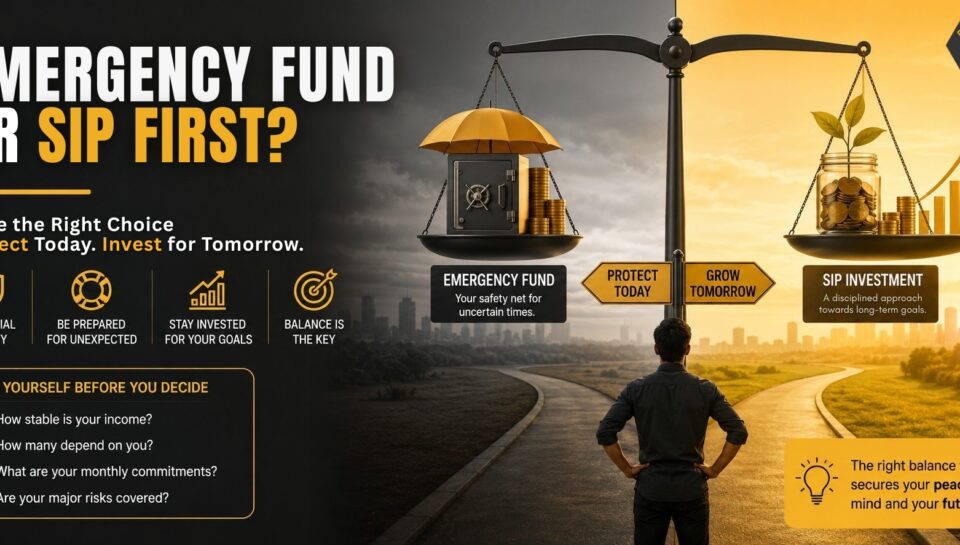
You have finally decided to start investing.You calculate your monthly expenses, select an amount and begin a SIP. Everything feels organised until an unexpected expense arrives. It could be a medical bill, an urgent home repair, a temporary income interruption or a sudden family responsibility. You need money immediately, but there is not enough available in your bank account. You are then left with a few uncomfortable options. You may have to stop your SIP, redeem an investment earlier than planned, use a credit card or borrow from someone.
This leads to an important question: was starting the SIP a mistake, or was starting it without a financial safety net the real mistake?
Many first-time investors face the same confusion. They know that delaying investments can affect their long-term goals, but they also understand the importance of keeping money aside for emergencies.
So, should you build an emergency fund first, or should you start a SIP?
Emergency Fund or SIP First: The Simple Answer
A basic emergency reserve should generally receive priority before you commit a large part of your monthly surplus to long-term investments. However, this does not mean that everyone must wait until the entire emergency fund is complete before starting a SIP. Some people may need to focus completely on building an emergency fund first. Others may be able to create a basic safety buffer and then build their emergency fund and SIP together.
The right sequence depends on your:
- Income stability
- Essential monthly expenses
- Existing EMIs and liabilities
- Number of financial dependants
- Insurance coverage
- Available savings
- Monthly surplus
An emergency fund and a SIP are both important, but they perform completely different jobs in your financial life.
Emergency Fund and SIP Perform Different Jobs
An emergency fund is created to protect you from unexpected financial situations. Its purpose is to ensure that you have accessible money when your regular income is disturbed or an urgent expense arises.
A SIP, or Systematic Investment Plan, is a method of investing a fixed amount regularly in a mutual fund. It is generally used for working towards longer-term financial goals.
The difference is simple: Your emergency fund protects your present financial stability. Your SIP helps you work towards your future financial goals.
The problem begins when people expect one to perform the job of the other.
A long-term investment should not become the first source of money every time life creates an emergency. Similarly, money meant for long-term goals should not be kept permanently idle simply because an emergency may occur someday.
The objective is to create the right balance between protection and progress.
What Is an Emergency Fund?
An emergency fund is money kept separately for unexpected and unavoidable financial situations. It may help during situations such as:
- A temporary job loss or delay in receiving income
- An urgent medical expense not fully covered by insurance
- A major home or vehicle repair
- An unexpected family responsibility
- A temporary interruption in business income
- An essential expense during a difficult financial period
An emergency fund is not meant for holidays, shopping, festivals, gadgets, planned home renovation or other predictable expenses. Those expenses should ideally have separate savings. The main purpose of an emergency fund is not to earn the highest possible return. Its purpose is to remain safe, accessible and available when it is genuinely required.
Starter Emergency Fund vs Complete Emergency Fund
One reason people delay investing is that the final emergency-fund target can initially look too large.
For example, if a household has essential monthly expenses of ₹75,000, creating several months of expenses may take time. Waiting until the entire amount is ready before starting any long-term investment may feel discouraging.
A more practical approach is to understand the difference between a starter emergency fund and a complete emergency fund.
What Is a Starter Emergency Fund?
A starter emergency fund is the first layer of financial protection. It is an accessible amount that can help manage smaller emergencies without immediately using a credit card, taking a loan or disturbing an investment.
The exact amount will differ for every household. The purpose is to create some breathing room before committing a larger amount towards long-term investments.
What Is a Complete Emergency Fund?
A complete emergency fund is a larger reserve based on several months of essential household expenses. Its size should reflect your actual responsibilities, income pattern and financial risks. A person with irregular business income may require a larger reserve than someone in a stable dual-income household.
This distinction is important because you may not always need to wait for the complete target before starting a small SIP. You can first build a basic safety buffer and then decide whether both goals can be managed together.
How Much Emergency Fund Should You Have?
A common guideline is to maintain a few months of essential expenses, but this should only be treated as a starting point. There is no single number that is right for every person.
Two people earning the same salary may require very different emergency funds. One may be unmarried, have no debt and live with their parents. The other may have a home-loan EMI, children, dependent parents and only one earning member in the family.
The emergency fund should therefore be calculated using your essential monthly commitments, not simply as a percentage of your salary.
What Should Count as an Essential Monthly Expense?
Your calculation may include:
- Rent or home-loan EMI
- Groceries and basic household expenses
- Electricity, water, phone and internet bills
- Insurance premiums
- Essential medicines and regular healthcare expenses
- School or education-related commitments
- Necessary commuting and transport costs
- Minimum loan repayments
- Financial support provided to parents or other dependants
- Basic society maintenance and household charges
Expenses such as holidays, entertainment, dining out, shopping and planned purchases should generally not be included in the emergency-fund calculation because they can be reduced or postponed during a financial difficulty.
Situations That May Require a Larger Emergency Fund
You may need a larger reserve when:
- Your income is irregular or commission-based.
- You are the only earning member of the household.
- Several family members depend financially on you.
- You have large EMIs or compulsory monthly payments.
- Your job or industry has uncertain income conditions.
- You run a business or work independently.
- Your family has ongoing medical requirements.
- Finding a similar source of income may take time.
A stable dual-income household with controlled liabilities may be comfortable with a different amount than a single-income household with several dependants. The correct target is the amount that helps your family manage essential commitments without immediately disturbing long-term investments or taking expensive debt.
The Hexo Emergency Readiness Check:
Before deciding whether to prioritise an emergency fund or SIP, ask yourself four practical questions.
1. How Stable Is Your Income?
Consider whether your income is fixed, variable, seasonal or dependent on business conditions. nAlso consider how long it may take to find another source of income if the current one stops.
A person receiving a stable salary and a self-employed professional with unpredictable cash flow should not automatically follow the same emergency-fund rule.
2. How Many People Depend Financially on You?
Your responsibility increases when parents, children, a spouse or other family members depend on your income. The more people who depend on one income, the more important accessible emergency savings become.
3. How High Are Your Compulsory Monthly Commitments?
Large EMIs, school fees, insurance premiums and medical expenses continue even when income is interrupted. Your emergency reserve should reflect expenses that cannot easily be postponed.
4. How Well Are Major Risks Already Covered?
An emergency fund and insurance perform different roles.
Health insurance may help cover eligible hospitalisation expenses, while term insurance can protect financial dependants in the event of the insured person’s death. An emergency fund can support expenses and situations that may not be covered by an insurance policy.
Insurance does not remove the need for emergency money, but adequate protection can reduce the possibility of one major event completely damaging the family’s finances.
Based on these r questions, most people will fall into one of the following situations.
Situation 1: Your Emergency Fund Needs Immediate Priority
Your emergency fund should receive greater priority when you have:
- No accessible savings
- Unstable or irregular income
- High-interest debt
- Large compulsory EMIs
- Multiple financial dependants
- Inadequate insurance coverage
- Frequent shortages before the end of the month
In such a situation, starting a large SIP may put unnecessary pressure on your monthly cash flow. When an unexpected expense arrives, you may be forced to stop the SIP, redeem the investment or borrow money. This can disturb your financial discipline before it has had a chance to develop.
The first objective should be to create basic financial stability. Once a starter reserve is available and your monthly cash flow becomes more comfortable, you can gradually consider long-term investing.
Situation 2: Build a Starter Fund and Then Work on Both
This situation may apply when you have:
- A reasonably stable income
- Some existing savings
- Adequate insurance protection
- No major high-interest debt
- A regular monthly surplus
You may first create a starter emergency reserve. After reaching that initial level, you can consider dividing your monthly surplus between completing the emergency fund and starting a manageable SIP.
This approach allows you to build financial protection without postponing long-term investing indefinitely.
The balance does not have to remain fixed. A larger amount can initially go towards emergency savings. As the reserve becomes stronger, more of the monthly surplus can gradually be directed towards long-term goals.
Situation 3: Your SIP Can Receive Greater Priority
You may be ready to focus more strongly on long-term investing when you already have:
- An adequate emergency reserve
- Stable household income
- Controlled liabilities
- Suitable insurance coverage
- No major short-term cash requirement
- A clear understanding of your goals and investment horizon
At this stage, your emergency fund is already performing its job. You can focus more of your available surplus on long-term financial goals while reviewing the emergency reserve periodically.
Can You Build an Emergency Fund and SIP Together?
Yes, some people can build both together. The decision depends on whether a basic level of financial protection already exists.
Consider a hypothetical example. Suppose a salaried person has a monthly surplus of ₹20,000 but only a small amount of accessible savings. Instead of immediately starting a SIP for the entire ₹20,000, the person may initially direct most of the surplus towards building a starter emergency reserve.
Once that basic reserve is available, the monthly surplus may be divided between:
- Continuing to build the complete emergency fund
- Starting a smaller SIP for a long-term goal
After the emergency-fund target is achieved, the amount previously going towards emergency savings can be redirected towards long-term goals. This is only an illustration. The actual allocation should depend on the person’s income, expenses, liabilities, risk profile and financial responsibilities.
The objective is not to find one perfect percentage. The objective is to avoid 2 extremes:
- Starting aggressive investments with no accessible savings
- Delaying all long-term investments for years while waiting for a perfect level of financial security
Where Should You Keep Your Emergency Fund?
Emergency money should be easy to access, relatively stable and separate from everyday spending.
Before selecting where to keep it, consider:
- How quickly the money can be accessed
- Whether its value can fluctuate significantly
- Whether there are penalties or restrictions on withdrawal
- Whether the money will be available during weekends or urgent situations
- Whether you understand the product and its risks
- Whether the fund is separate from your regular spending account
You may also divide the emergency reserve instead of keeping the entire amount in one place. A portion may remain immediately accessible, while the remaining amount may be kept in an option selected after understanding its liquidity, risk, taxation and withdrawal conditions.
Avoid choosing an option only because it may offer a higher return. Emergency money has a different purpose from long-term investment money.
A Practical Example for a Family Living in Thane
Consider a hypothetical family living around Hiranandani Estate or Ghodbunder Road. Their essential monthly commitments may include a home-loan EMI or rent, society maintenance, groceries, school fees, insurance premiums, medical expenses, commuting costs, support for parents and other loan payments.
Suppose their total essential monthly commitments are ₹1 lakh. Their emergency-fund target should not be decided only by copying a general number from the internet. They should also consider:
- Whether the household has one income or two
- How stable both incomes are
- How much insurance protection is available
- Whether they have dependent parents or children
- How long it may take to replace an interrupted income
- Whether any large compulsory payment is due in the coming months
A stable dual-income household may make a different decision from a family depending on one income, even when both households have similar monthly expenses. The location may affect the cost of living, but the emergency-fund target is ultimately decided by the household’s actual commitments and financial situation.
Common Emergency-Fund Mistakes to Avoid
1) Counting a Credit Card as an Emergency Fund:
A credit card provides borrowed money, not your own financial reserve. It may help temporarily, but it also creates a repayment obligation and can become expensive when dues are not cleared on time.
2) Keeping the Entire Amount in a Volatile Investment:
An emergency may arrive when financial markets are down. Depending entirely on a volatile investment may force you to withdraw at an unfavourable time.
3) Calculating the Fund Using Your Salary:
Your emergency-fund requirement should be based on essential household expenses, not automatically on your total income.
4) Using Emergency Money for Planned Purchases:
A holiday, gadget, festival expense or home renovation is not an emergency when it can be planned in advance.
5) Keeping It in the Regular Spending Account:
When emergency money is mixed with routine spending money, it can gradually be used without being noticed.
6) Forgetting to Rebuild It:
If you use part of the emergency fund, rebuilding it should become a priority once your financial situation stabilises.
7) Never Reviewing the Amount:
Household expenses change over time. Marriage, children, a home loan, dependent parents, inflation or a change in income may increase the amount required.
8) Starting an Uncomfortable SIP:
A SIP amount should not make it difficult to manage basic expenses or force you to borrow whenever an unexpected cost arises.
Frequently Asked Questions:
1. Should I Complete My Emergency Fund Before Starting a SIP?
Not necessarily in every situation. A person with no accessible savings or unstable income may need to prioritise the emergency fund first. Someone with stable income and a starter reserve may be able to build the remaining emergency fund and begin a small SIP together.
2. Can I Start a Small SIP While Building My Emergency Fund?
You may be able to do both when your income is stable, essential expenses are comfortably managed, high-interest debt is controlled and a basic safety reserve is already available.
3. How Much Emergency Fund Should a Salaried Person Maintain?
The amount depends on income stability, essential expenses, EMIs, dependants, insurance and how quickly another source of income could be arranged. A fixed number cannot be suitable for every salaried person.
4. Should EMIs Be Included While Calculating an Emergency Fund?
Yes, compulsory EMIs and minimum loan repayments should be considered because they generally continue even during an income interruption.
5. Is a Credit Card an Alternative to an Emergency Fund?
No. A credit card is a form of borrowing and creates a repayment obligation. An emergency fund consists of your own accessible money.
5. What Is the Difference Between Savings and an Emergency Fund?
Savings may be kept for planned expenses and short-term goals. An emergency fund is specifically reserved for unexpected and unavoidable financial situations.
6. How Often Should I Review My Emergency Fund?
Review it whenever your income, household expenses, dependants, loans or family responsibilities change. It is also sensible to review it periodically even when no major change has occurred.
Protection First, Then Progress
An emergency fund and a SIP should not be treated as competitors. Your emergency fund protects your financial stability when life does not go according to plan. Your SIP helps you invest regularly towards longer-term goals.
The real question is not which one is more important forever. The better question is: which one needs greater priority in your present financial situation?
Build enough protection so that an unexpected expense does not repeatedly disturb your investments. At the same time, do not postpone long-term investing indefinitely when your financial foundation is already strong enough to begin.The right balance allows your emergency fund to protect your investment journey while your investments continue working towards your future goals.
Ready to Begin Your Mutual Fund Investment Journey?
Once your basic financial safety foundation is in place, the next step is to begin investing according to your goals, risk profile and investment horizon.
Connect with Hexo Wealth Associates LLP, an AMFI-registered Mutual Fund Distributor in Hiranandani Estate, Thane, to understand the mutual fund investment process.
ARN: 353817
Disclaimer
This article is intended solely for investor education and general information. It should not be treated as investment advice or as a recommendation to invest in any particular mutual fund scheme or security. Investment suitability depends on factors including the investor’s objectives, risk profile, investment horizon and financial circumstances. The examples used in this article are hypothetical and are provided only to explain the concepts discussed.
Hexo Wealth Associates LLP is an AMFI-registered Mutual Fund Distributor, ARN: 353817, and may receive commissions from Asset Management Companies on investments made under Regular Plans.
Mutual Fund investments are subject to market risks, read all scheme related documents carefully.