


SIP Returns Low? Should You STOP, CONTINUE or Increase Your Investment?
You have been investing every month. The SIP debit happens on time, the investment has been running for a few years, but when you open the portfolio, the return is nowhere close to what you expected.
That experience has become particularly relevant in 2026. Nearly 10 crore SIP accounts contributed ₹32,160 crore in October alone, even as a difficult equity-market phase left many investors looking at muted or negative recent returns.
So should you stop the SIP, continue it, or increase the amount?
Before choosing any of those three actions, separate two questions that investors often mix together:
- How is my investment performing?
- Am I actually building enough money for my goal?
They are not the same question.
A SIP can show Low SIP Returns while still making reasonable progress towards a distant goal. Another SIP can deliver respectable returns but still leave you far short because the monthly contribution was never large enough.
Understanding which problem you actually have should come before changing the SIP.
Why Are Your SIP Returns Low?
Low returns do not always mean the mutual fund is poor. The number visible on your screen can be influenced by the market phase, how recently you started, how the fund has performed relative to relevant comparisons, and how much you have actually contributed.
Here are 5 situations worth separating:
1. Market volatility is affecting your portfolio:
Equity markets do not rise in a straight line. A correction can reduce the NAV of equity-oriented mutual funds even when nothing fundamental has changed about your original investment goal.
This is particularly visible when an SIP began near a strong market phase. Earlier instalments may have purchased units at higher NAVs, while later instalments during a correction purchase more units for the same monthly amount.
That is how rupee-cost averaging works mathematically.
But buying more units at a lower NAV does not guarantee that the investment will recover or produce a particular return. The relevant question is whether the underlying fund and remaining investment horizon still make sense for the goal.
2. Your investment period is too short:
Suppose you started an equity SIP nine months ago and expected to see a steady annual return immediately.
That expectation itself may be the problem.
Every SIP instalment has been invested for a different period. Your first ₹10,000 may have been invested for nine months, while the most recent ₹10,000 may have been invested for only a few weeks.
This means an SIP that has been running for one year does not mean every rupee has received one full year to grow.
For market-linked equity investments, shorter periods can therefore produce results that look very different from long-term expectations. The investment horizon should be judged against the goal and the mutual fund category, not against an assumed return that was expected every calendar year.
3. Your fund is underperforming its benchmark or category:
Now consider a different situation.
The broader market has recovered. Comparable funds have also improved. But your scheme continues to lag its relevant benchmark and category across meaningful periods.
That deserves a Mutual Fund Performance Review.
Do not judge the scheme only because another fund currently sits at the top of a return table. Instead, examine:
- Performance against the appropriate benchmark.
- Performance relative to comparable schemes.
- Behaviour across different market periods.
- Changes in investment strategy or portfolio.
- Changes in fund management.
- Concentration and risk characteristics.
SEBI’s current framework provides for category-relevant benchmarking, and scheme disclosures also allow investors to see performance alongside benchmark and risk information.
One weak quarter or year need not automatically make a fund unsuitable. Persistent relative weakness deserves a different level of investigation.
4. Your investment amount does not match your financial goal:
This is the mistake return numbers can hide.
Suppose your mutual fund SIP has delivered a reasonable return, but the goal requires ₹1 crore in fifteen years and you are investing only ₹5,000 per month.
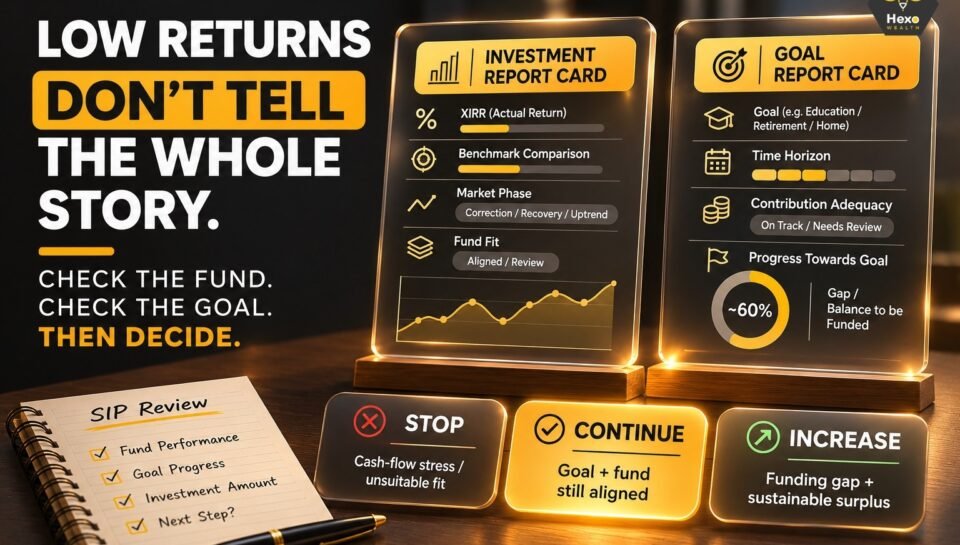
The fund may not be the problem. The contribution may be. This is why a SIP has two report cards:
|
Report Card |
What It Answers |
|
Investment Performance |
How has the investment actually performed? |
|
Goal Progress |
Is enough money being accumulated for the requirement? |
A good investment return cannot automatically compensate for an inadequate contribution. Similarly, increasing a contribution cannot repair a fundamentally unsuitable fund. Before blaming SIP Investment Returns, check whether the amount invested was realistic for the goal in the first place.
5. Your portfolio may lack suitable diversification:
Owning several SIPs does not automatically mean the portfolio is diversified. Different mutual funds can hold similar securities, favour similar sectors or create repeated exposure to the same market-cap segment. You may therefore have six SIPs but considerably fewer genuinely different investment exposures.
When Mutual Fund SIP Returns appear disappointing, look at the combined portfolio as well as each scheme separately.
Check whether:
- Several funds are doing the same job.
- One market segment has become dominant.
- Too much of the portfolio depends on a particular category or style.
- The overall allocation still fits the investment horizon and stated risk profile.
The number of SIPs is not the same as the number of useful portfolio roles.
How Should You Evaluate Your SIP Performance?
Before choosing STOP, CONTINUE or INCREASE, give your SIP both of its report cards. One measures performance. The other measures progress.
Understand Absolute Returns and XIRR
Suppose you have invested ₹3 lakh through monthly SIPs and the portfolio is now worth ₹3.30 lakh.
A simple calculation tells you that the portfolio is 10% above the amount invested.
But that does not account for the fact that the first instalment has been invested much longer than the last.
For SIPs with cash flows occurring on different dates, XIRR is commonly used because it annualises the return while considering the timing and amount of each cash flow.
A useful distinction is: CAGR tells what the fund did. XIRR tells what you earned.
For a one-time investment, CAGR can be useful over longer periods. For an SIP where money enters at different dates, your actual investor experience requires those cash-flow dates to be considered.
Also be careful about overinterpreting annualised numbers over very short periods. A few months of SIP history is usually too little information to judge a long-term investment strategy.
Use a SIP Calculator for Better Planning
Return measurement answers what has happened.
A calculator can help explore what may happen to the goal under different mathematical assumptions.
For example, suppose your current portfolio is ₹8 lakh and your monthly SIP is ₹15,000. The more useful questions may be:
- What happens if the same SIP continues?
- What difference could a future Step-Up make?
- What if a bonus is invested later?
- What happens if money needs to be withdrawn for another goal?
The Hexo SIP Calculator can incorporate an existing portfolio, monthly SIP, Step-Up SIP, future lumpsum investments and planned withdrawals in one illustration. The output depends entirely on the assumptions entered and is not a forecast or guarantee of actual mutual fund returns.
This is particularly useful when your investment performance looks reasonable but your goal report card still shows a possible shortfall.
Compare Performance With Relevant Benchmarks
A fund being in profit does not automatically mean it has performed well.Imagine your fund delivered 6% while an appropriate benchmark delivered 12% over a comparable period. You made money, but the relative performance still deserves examination.
The reverse can also happen.
Your fund may be down 7% during a difficult market period while its relevant benchmark is down 10%. The portfolio is in loss, but the fund has not necessarily underperformed that comparison.
So do not ask only: “Am I making money?”
Also ask whether the scheme’s performance is reasonable for the investment objective, benchmark, category and risk being taken.
Should You STOP Your SIP?
Stopping an SIP and selling the units already accumulated are two different decisions.
Stopping the SIP prevents future instalments. The existing mutual fund units generally remain invested unless a separate redemption transaction is placed.
A stop or reduction may need consideration when:
- Income has materially reduced.
- Essential expenses or liabilities have increased.
- Emergency liquidity needs rebuilding.
- The financial goal or timeline has changed.
- The investment no longer fits the stated risk profile.
- A deeper fund review identifies persistent concerns.
- The money is now required for a more immediate responsibility.
Notice what is not on that list: “My return was disappointing this month.”
A temporary cash-flow problem can also lead to a different response from a permanent investment problem. In some circumstances, reducing or pausing future contributions may be a cash-flow decision without automatically implying that the existing investment should be redeemed.
Should You CONTINUE Your SIP?
Continuing may be reasonable when the original goal remains relevant, the remaining horizon is appropriate, the fund continues to perform its intended role and the contribution remains affordable.
But “continue” should not mean “ignore”.
Use both report cards.
Investment report card:
Ask whether:
- Relative performance remains reasonable.
- The fund’s characteristics remain consistent with its intended role.
- Its risk remains appropriate.
- The overall portfolio is not becoming unnecessarily concentrated.
Goal report card:
Ask whether:
- The estimated future requirement is still realistic.
- Enough time remains.
- Existing investments are progressing reasonably towards the target.
- The current monthly contribution is still meaningful for the expected requirement.
If both remain broadly intact, a temporary period of lower returns may not itself require a change.
In October 2026, almost 10 crore contributing SIP accounts continued investing despite a difficult market environment. That does not mean continuing is automatically right for every investor, but it illustrates why the decision should be based on individual circumstances rather than market sentiment alone.
Should You INCREASE Your SIP Investment?
This is where another common misunderstanding appears.
A lower NAV does not automatically mean: “My investment is cheaper, so I should double the SIP.”
Increasing an SIP is a new allocation decision.
It may deserve consideration when your income has increased, you have additional sustainable monthly surplus, the financial goal requires a higher contribution, or the existing SIP has become too small relative to the target.
Before increasing it, review 5 things:
- Cash flow: can the higher contribution continue comfortably even if an expensive month arrives?
- Goal requirement: does the goal actually need the additional contribution?
- Time horizon: is the selected mutual fund category still appropriate for the time remaining?
- Risk: would you remain comfortable if markets fell further after increasing the SIP?
- Portfolio allocation: would the additional contribution create excessive exposure to the same category?
Increasing an SIP purely because recent returns are disappointing can confuse two separate problems. If the fund is the problem, more money does not solve it. If the goal funding is the problem and the investment remains appropriate, a higher contribution may be the variable worth examining.
Why Regular Portfolio Reviews Matter
A useful review should not begin with: “Which fund should I change?” It should begin with: “Which report card has actually weakened?”
- If investment performance has deteriorated relative to relevant comparisons, investigate the fund.
- If the investment is behaving reasonably but the expected corpus is falling short, investigate the contribution, remaining time and goal assumptions.
- If both are fine, the review may legitimately conclude that nothing needs changing.
That is an important outcome because a portfolio review is not successful only when it produces a transaction.
For investors looking for a Mutual Fund Distributor in Thane, the distributor’s role can include facilitating eligible mutual fund transactions and discussing existing mutual fund holdings in the context of the investor’s stated goals, horizon, risk profile and circumstances.
How Hexo Wealth Can Help With Your Investment Journey
Hexo Wealth Associates LLP is an AMFI-registered Mutual Fund Distributor | ARN 353817.
For eligible mutual fund investors, Hexo’s distribution and servicing process can include:
- Understanding the investor’s stated financial goal and investment horizon.
- Reviewing existing mutual fund holdings.
- Understanding the stated risk profile and circumstances.
- Explaining relevant mutual fund scheme information.
- Facilitating SIP and lump-sum investments through Regular Plans.
- Facilitating eligible switches, redemptions and related servicing requests.
- Periodically discussing whether existing mutual fund holdings continue to remain connected with the stated goal and timeline.
The starting question does not always need to be: “Should this SIP stop?”
Sometimes the more useful questions are:
- “What exactly is disappointing: the investment return, or the progress towards the goal?” and
- “What problem would changing the SIP actually solve?”
Hexo Wealth Associates LLP is not a SEBI-registered Investment Adviser.
Lorem ipsum dolor sit amet, consectetur adipiscing elit. Ut elit tellus, luctus nec ullamcorper mattis, pulvinar dapibus leo.
Frequently Asked Questions About SIP Returns
1. Why are my SIP returns low even after investing regularly?
Low returns can result from a weak market phase, a short investment history, fund-specific underperformance, portfolio concentration or the timing of your SIP instalments.
Regular investing does not guarantee a particular return. Review both how the fund has performed relative to relevant comparisons and whether the investment still fits the original goal and remaining horizon.
2. Should I stop my SIP if it is showing negative returns?
Not automatically.
A negative return may reflect a broader market decline rather than a problem with the specific mutual fund. Before stopping, check the fund, investment horizon, goal, risk profile and your own financial circumstances.
Also remember that stopping future SIP instalments and redeeming the units already held are separate actions.
3. Can my SIP returns be low even if the fund is performing reasonably?
Yes.
If the broader market or category is weak, your SIP can show a low or negative absolute return even while the scheme performs reasonably against an appropriate benchmark.
That is why absolute profit or loss should not be the only measure used when reviewing a mutual fund.
4. What if my SIP return is good but my financial goal is still behind?
Then the investment return may not be the main problem.
The required corpus may have increased, the original SIP amount may have been too low, or the time available may have shortened. In that situation, review the goal requirement, existing portfolio and contribution rather than automatically changing the fund.
5. How can I calculate my actual SIP returns?
For SIPs involving several cash flows at different dates, XIRR is commonly used to measure the investor’s annualised return because it accounts for both the amounts and their timing.
A basic comparison of current value versus total invested amount shows absolute gain or loss but does not capture how long each SIP instalment has actually been invested.
6. How long should I stay invested to get better SIP returns?
There is no fixed holding period that guarantees a positive return.
The appropriate horizon depends on the mutual fund category, goal and investor circumstances. Equity-oriented investments can experience substantial short-term fluctuations, so the time available before the money is needed matters considerably.
7. Should I increase my SIP when returns are low?
Low returns alone are not a sufficient reason to increase the SIP.
A higher contribution may be considered when the financial goal requires it, sustainable cash flow is available, the investment remains suitable for the horizon and the resulting portfolio allocation remains appropriate.
Increasing the SIP should solve a funding problem, not simply express a view that markets must recover soon.
Disclaimer
This article is intended solely for general investor education and information. It should not be treated as personalised investment, tax, legal or financial advice, detailed financial planning, or as a recommendation to start, stop, continue, increase, reduce, switch, redeem or hold any particular mutual fund scheme or investment.
Terms including Low SIP Returns, Mutual Fund SIP Returns, SIP Investment Returns, SIP performance and related concepts are used for educational purposes. Historical returns, benchmark comparisons, XIRR and short-term portfolio movements should not be interpreted in isolation as instructions to undertake any transaction.
Calculator outputs are mathematical illustrations based on the inputs and return assumptions selected. They are not forecasts, assurances or guarantees of actual mutual fund returns or achievement of any financial goal.