



Best Child Future Planning Services in Thane: A Parent's Guide to Securing Your Child's Future
Every parent wants to give their child access to the right opportunities, whether that means higher education, a professional course, overseas studies or another important milestone.
The difficult part is that the goal is often many years away, while the cost is unknown today.
A course that appears manageable now may cost substantially more 10 or 15 years later. And the final requirement may include much more than tuition fees.
If you are searching for the Best Child Future Planning Services in Thane, a useful starting point is not simply asking, “How much should I invest?”
It is first understanding what you are preparing for, when the money may be needed, and what the complete future cost could look like.
What Is Child Future Planning?
Child future planning means preparing financially for important future goals such as higher education, professional courses, overseas studies, career-related opportunities or other major milestones.
A structured approach considers the expected goal, time available, future cost, inflation, existing investments and ongoing contributions so that parents can prepare without losing sight of their other financial priorities.
Why Child Future Planning Has Become More Important Than Ever
One of the biggest advantages parents have is time. But that advantage reduces every year the goal gets closer.
Education costs can rise significantly over a long period. The course itself may also change, and overseas education can bring additional expenses such as accommodation, travel, insurance and other living costs.
Starting earlier gives parents more time to build towards the goal instead of trying to arrange a large amount when admission is only a few years away.
But starting early is only useful when you have some idea of what number you are actually working towards.
How Rising Education Costs Can Impact Your Child's Future
Consider how a current education cost may change over 15 years.
Current Education Cost | Illustrative Cost After 15 Years* |
₹10 Lakh | ₹24–28 Lakh |
₹20 Lakh | ₹48–55 Lakh |
₹50 Lakh | ₹1.20–1.38 Crore |
Illustrative figures assuming education-cost inflation of approximately 6% to 7% annually. Actual costs and inflation may differ.
This is why planning only with today’s college fees can create a misleading sense of preparedness.
Parents should also think about what sits around the course fee, including accommodation, travel, books, equipment, deposits, insurance and other living expenses.
Ready to Take the First Step?
You do not need to know exactly what your child will study 10 or 15 years from now. You do need a starting estimate that can evolve as your child’s future becomes clearer.
Begin with the CLASS Framework, estimate the possible future requirement, compare it with what you are already building and review the gap periodically.
If you want to understand mutual fund investment options in the context of your child’s education goal, investment horizon, financial circumstances and risk profile, you can connect with the Hexo Wealth team.
Hexo Wealth Associates LLP is an AMFI-registered Mutual Fund Distributor | ARN-353817.
Questions Every Parent Should Ask Before Starting Child Future Planning
1. What Is the Goal?
Is the money likely to be required for:
- College education?
- Post-graduation?
- Professional courses?
- Overseas studies?
- Another major education or career milestone?
You do not need to predict your child’s exact career when they are five years old. You simply need a reasonable starting scenario that can be updated later.
2. How Many Years Do I Have?
A parent whose child is three has a very different time horizon from a parent whose child is fifteen.
Time influences both the future cost of the goal and how long the investments have to grow.
3. What Could the Goal Cost in the Future?
Do not stop at today’s course fee. Estimate the complete cost first and then account for inflation over the remaining years.
4. How Much Is Already Earmarked?
Look specifically at investments that you genuinely consider available for this goal.
Counting every family asset can make the goal appear better funded than it really is.
5. Am I Investing Consistently?
Knowing your SIP amount is useful, but it does not tell you whether the SIP is enough.
The better question is whether your existing amount + future contributions appear capable of meeting the estimated future requirement.
The CLASS Framework: A Simple Way to Think About Your Child's Education Goal
Once you have answered the five questions above, use the CLASS Framework to turn the goal into something more practical.
C: Course & Country:
Start with a likely course path and whether the goal may be in India, overseas, or whether you want to prepare for both possibilities.
The objective is not to predict your child’s future perfectly. It is to create a realistic base scenario instead of planning without a number.
L: Living + Learning Costs:
Do not calculate tuition alone.
Include costs that may accompany the course, such as accommodation, travel, books, equipment, insurance, deposits and other living expenses.
For overseas education especially, these additional costs can materially change the overall requirement.
A: Amount in the Future:
Once you have an estimate of today’s complete cost, calculate what that amount may become by the year in which the money is required.
This is where the goal changes from: “College costs around ₹20 lakh today” to:“This is approximately what we may need when my child actually reaches college.”
That second number is far more useful for planning.
S: Shortfall + Step-Up:
Now compare the estimated future goal with:
- Investments already earmarked
- Existing monthly SIPs
- Time remaining
- Expected future contributions
This shows whether there may be a funding gap.
If there is one, the answer does not always have to be one very large increase today. Parents can also explore whether contributions can gradually increase as income grows.
S: Shift Near the Goal:
A goal that is 12 years away and a goal that is 18 months away should not necessarily be treated in the same way.
As the education date gets closer, the focus should gradually move towards reducing dependence on short-term market movements and preparing for the actual withdrawal, liquidity and timing of the expense.
The CLASS Framework therefore asks parents to think beyond just “Which SIP should I start?” and instead connect the course, complete cost, future amount, funding gap and time left before the money is required.
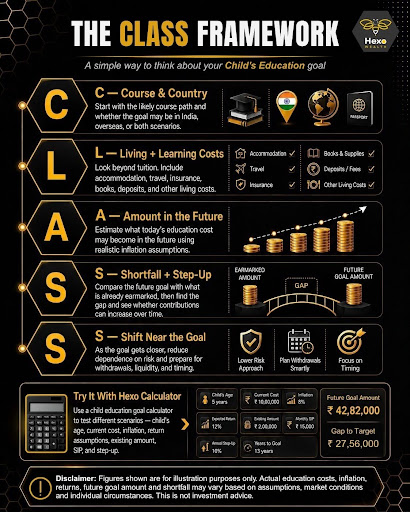
Try Your Numbers With the Hexo Child Education Calculator
Once you have worked through CLASS, you can test your assumptions using the Hexo Child Education Calculator.
Enter details such as the current education cost, time remaining, existing education-focused investments, current SIP, annual SIP step-up and your inflation and return assumptions. The calculator can then illustrate the estimated future education cost, projected portfolio value and whether there may be a funding shortfall or surplus.
You can also change the assumptions to compare different scenarios. This can be especially useful when you are unsure whether to prepare for an India-based course, overseas education, a higher cost assumption or a gradual increase in contributions.
Treat the output as an illustration, not a guarantee. Education costs, inflation, investment returns and your child’s eventual choices can all change over time.
Child Education Planning vs Child Future Planning
These terms are often used interchangeably, but they are not exactly the same.
Child Education Planning
Usually focuses specifically on:
- College education
- Professional courses
- Post-graduation
- Overseas education
- Other learning-related expenses
Child Future Planning
Takes a broader view and may also consider:
- Education goals
- Career-development opportunities
- Future financial support
- Other major life milestones
In simple terms, education planning can be one part of preparing for your child’s wider future needs.
A Real-Life Scenario: Starting Early vs Starting Late
Consider two parents preparing for the same future education requirement.
Parent A
- Starts when the child is 3
- Has 15 years to prepare
Parent B
- Starts when the child is 10
- Has only 8 years to prepare
Parent A does not know exactly which course the child will eventually choose either.
The difference is that Parent A has more time to build, review and adjust the goal as the child grows.
That flexibility is one of the biggest advantages of starting early. You do not have to get every assumption right on day one. You simply have more opportunities to correct course.
Signs Your Child Future Plan May Be Off Track
It may be time to review the goal if:
- There is no amount specifically earmarked for your child’s future
- You know your SIP amount but not the future goal amount
- You calculated only today’s education cost
- You considered tuition but ignored living and associated costs
- The expected course or country has changed but the goal amount has not
- You have not reviewed the goal for several years
A useful child future plan should change when the underlying assumptions change.
What Parents Should Consider While Planning
For families, children may eventually study locally, elsewhere in India or overseas.
That makes it useful to consider more than one possible scenario instead of building the entire goal around a single college or course many years in advance.
Parents may need to account for:
- Rising higher-education costs
- Potential overseas education
- Professional or specialised courses
- Additional skill-development opportunities
- Accommodation and travel requirements
- Other long-term family goals
One important point is often overlooked here.
Your child can potentially access education funding. You cannot take an education loan for your own retirement.
So child-related goals should not be prepared for by continuously sacrificing your own long-term financial security.
While preparing for your child’s future, also keep your retirement requirement visible. You can explore our guide on Retirement Planning Services in Thane to understand how the two long-term goals can be viewed together.
Why Goal-Based Planning Matters More Than Product Selection
One of the first questions parents often ask is: “Which investment should I choose for my child?”
But that question comes too early. A better sequence is: What is the goal? → When is it required? → What could it cost? → What is already available? → What is the gap?
Only after those questions become clearer does it make sense to evaluate investment options based on the goal, time horizon and risk profile.
This reduces the temptation to keep changing investments simply because a new product, fund or market trend is receiving attention.
Why Early Planning Matters
Starting early provides more than additional years for potential investment growth.
It also gives parents room to be wrong.
The course may change. The preferred country may change. Costs may rise differently from what you assumed. Your income and ability to invest may also change.
When you begin early and review periodically, you have more time to adapt instead of making large last-minute changes.
What Is the Best Way to Plan for Your Child's Future?
A useful starting approach is to:
- Define a reasonable education or future-goal scenario.
- Estimate the complete current cost.
- Account for inflation until the goal year.
- Identify investments already earmarked for the goal.
- Compare the projected amount with the future requirement.
- Review the gap and your ongoing contribution.
- Revisit the assumptions as your child grows.
- Gradually prepare for liquidity as the goal gets closer.
The aim is not to predict everything perfectly today. It is to keep improving the estimate as the future becomes clearer.
Expert Insight:
A ₹15,000 SIP does not tell you whether your child’s education goal is on track.
It only tells you how much you are currently investing. To understand the goal properly, connect four numbers: Future Goal Amount + Existing Earmarked Amount + Ongoing Contributions + Years Remaining
Then ask one question: Is what I am building likely to meet what I may eventually need?
That gap, rather than the SIP amount alone, is the number worth reviewing.
Steps to Plan for Your Child's Future
- Define the likely goal and timeline.
- Estimate learning and living costs.
- Calculate the potential future amount.
- Identify the amount already earmarked.
- Estimate the funding gap.
- Start or continue consistent goal-linked investments.
- Explore a step-up as income increases, where appropriate.
- Review the goal periodically.
- Prepare for withdrawals and liquidity as the goal approaches.
Frequently Asked Questions
The earlier you begin, the more time you have to build towards the goal and adjust your assumptions along the way. However, even if you are starting later, understanding the future requirement and available time is still a useful first step.
A Child Education Calculator can illustrate how today’s estimated education cost may change over time after accounting for inflation. It can also help compare the estimated future requirement with existing investments and ongoing contributions to identify a possible funding gap.
If education costs increase over time, using only today’s fees may underestimate the amount eventually required. Inflation therefore needs to be considered when estimating a long-term education goal.
No. Education may be the largest goal, but parents may also want to prepare for professional development, career-related opportunities or other important future milestones.
A SIP is one way of investing regularly in mutual funds towards a long-term goal. Whether a particular mutual fund investment is suitable depends on factors such as the goal, investment horizon, financial circumstances, risk profile and the features and risks of the scheme.
A yearly review can be a useful starting point. The goal should also be revisited when there is a significant change in the expected course, study country, cost, investment contribution, timeline or family circumstances.