


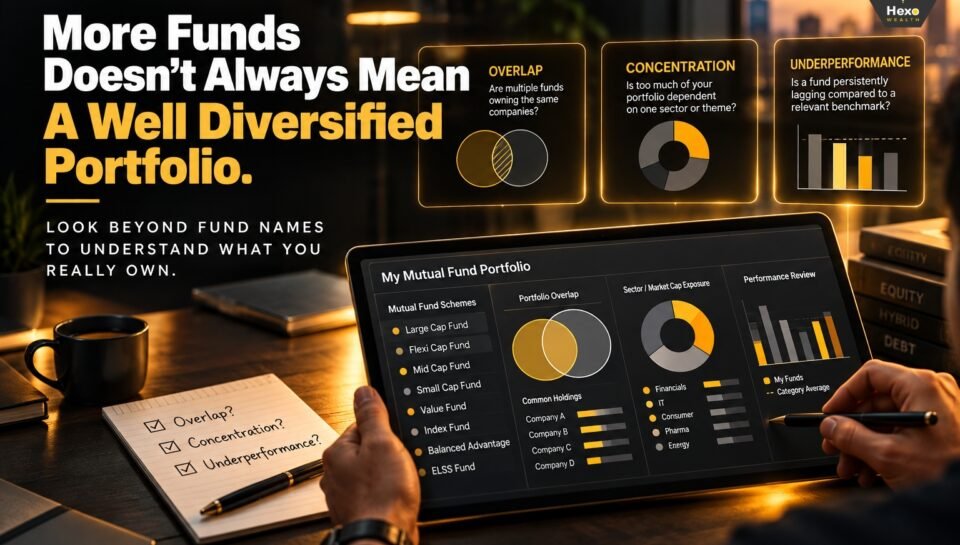
Mutual Fund Portfolio Review: How to Identify Overlap, Concentration Risk and Underperformance
Owning several mutual funds can create a comforting feeling that your money is well diversified. One fund may be large cap, another flexi cap, another mid cap, and a few more may have been added through SIPs over different years.
But the number of fund names on your statement does not tell you what your portfolio actually owns.
Two funds may repeatedly hold the same companies. Several different funds may collectively create a large exposure to one sector or market-cap segment. And a fund that looks weak on a one-year return table may simply be behaving differently from the rest of the portfolio rather than being fundamentally unsuitable.
That is why a Mutual Fund Portfolio Review should separate three very different questions:
- Are my funds duplicating each other?
- Is my overall portfolio becoming concentrated?
- Is a fund genuinely underperforming?
These are three different problems, and they should not automatically lead to the same action.
India’s mutual fund industry had grown to ₹82.64 lakh crore of assets and 28.62 crore folios by September 30, 2026. A folio is an account rather than a unique investor, but the numbers still show how deeply mutual funds have become part of household investment portfolios.
The more funds you accumulate, the more important it becomes to stop counting schemes and start understanding exposures.
Start Your Mutual Fund Portfolio Review With Three Different Lenses
A useful Mutual Fund Portfolio Analysis does not begin by ranking every fund from best to worst.
It begins by separating three issues that are often confused with one another.
What You Are Checking | The Question |
Portfolio Overlap | Are multiple funds owning the same underlying investments? |
Concentration Risk | Is too much of my total portfolio dependent on one type of exposure? |
Underperformance | Is a fund persistently lagging a relevant comparison after considering its role and risk? |
This distinction matters because the solution changes depending on which problem actually exists.
A portfolio may have overlap without serious concentration. Another may have relatively low stock-level overlap but still be heavily concentrated in small caps or one theme. A third may contain a temporarily underperforming fund that adds something genuinely different to the portfolio.
Before changing a fund, identify the problem first.
1. How to Identify Mutual Fund Portfolio Overlap
Mutual Fund Portfolio Overlap occurs when two or more schemes own some of the same underlying securities.
But simply asking, “How many stocks are common?” can be misleading.
Suppose two funds share ten stocks.
In one case, those stocks may represent only a small portion of each portfolio. In another, the same ten companies may make up half of both funds.
Those situations are very different. A more useful approach is weighted overlap.
For a shared company, compare how much each fund has invested in it and use the lower weight as the overlapping exposure. For example, if Fund A has 8% in Company X and Fund B has 5%, the common exposure attributable to that security is 5%. Current regulatory methodology uses this lower-weight approach when calculating scheme-level portfolio overlap.
So when reviewing two funds, look beyond the number of common stocks and examine:
- Which securities are common?
- What percentage does each fund hold?
- Are the largest holdings repeatedly appearing?
- Are the funds from similar categories?
- Do they perform different roles despite some common holdings?
There is also no useful universal rule that says every portfolio becomes problematic once overlap crosses one fixed percentage.
Context matters.
Two large-cap funds may naturally show greater overlap because their investible universe is narrower. Under the current categorisation framework, a large-cap fund invests predominantly in the top 100 companies by market capitalisation.
The better question is therefore: “Is the overlap helping me achieve a deliberate portfolio structure, or am I unknowingly paying for the same exposure several times?”
2. Look for Mutual Fund Concentration Risk Separately
Overlap and concentration are related, but they are not identical. Mutual Fund Concentration Risk appears when too much of the complete portfolio depends on a narrow set of exposures.
That concentration could be in:
- A few individual companies
- One sector
- One market-cap segment
- One investment style
- One theme
- Similar fund categories
Imagine you hold four funds with relatively low stock-level overlap. That sounds diversified.
But suppose all four are heavily tilted towards mid and small-cap companies. Your common-stock overlap may be modest while your market-cap concentration remains high.
Similarly, one banking fund and another financial-services-oriented exposure may hold somewhat different companies while still making the overall portfolio heavily dependent on one part of the economy.
This is why Mutual Fund Diversification should be checked at the complete portfolio level rather than fund by fund.
A useful review asks: What percentage of my complete mutual fund portfolio is exposed to each company, sector, market-cap segment and category?
That tells you much more than simply knowing how many schemes you own.
3. Don’t Confuse Diversification With More Funds
It is easy to accumulate mutual funds over time.
You may start one SIP after joining your first job, add another after a salary increase, invest in an ELSS for tax purposes, pick up a thematic fund during a popular market cycle and later add a flexi-cap fund because its recent performance looks attractive.
Eventually, you have seven funds.
But seven funds are useful only if those seven funds create meaningful roles in the portfolio.
Consider two investors:
Investor A | Investor B |
4 mutual funds | 8 mutual funds |
Clearly different roles | Several similar categories |
Limited unintended duplication | Repeated top holdings |
Allocation understood | Allocation accumulated gradually |
Investor B owns more schemes but may have less clarity. So there is no magic number of mutual funds that automatically produces good Mutual Fund Diversification.
The better test is: If one fund disappeared from the portfolio, what useful exposure or role would actually be lost?
If the answer is “almost nothing”, that fund deserves closer examination.
4. How to Evaluate Underperforming Mutual Funds
This is where many portfolio reviews go wrong.
An investor opens an app, sorts funds by one-year return and immediately finds the “worst” fund. That is not enough to identify Underperforming Mutual Funds.
Start with four checks:
1) Compare it with the right benchmark:
A mid-cap fund should not be judged simply because a large-cap fund delivered a better return during a particular period. The investment universe and risk profile may be different.
2) Compare it with relevant peers:
If most funds in the same category struggled during the same period, the issue may partly reflect the category or investment style rather than one particular scheme.
3) Look across meaningful periods:
One start date and one end date can produce a misleading impression. Rolling periods can help show how consistently a fund has behaved across multiple entry points rather than relying only on one point-to-point return.
4) Ask what changed:
Persistent weak relative performance deserves further investigation, particularly if it coincides with changes such as:
- Fund-management changes
- Meaningful portfolio changes
- Style or mandate changes
- Rising concentration
- A change in the role the fund performs in your portfolio
Current discussions around underperforming funds similarly distinguish temporary weakness from persistent lag and caution against switching merely because another fund has recently performed better.
The important question is not: “Is this the lowest-return fund I own?”
It is: “Is the reason I originally owned this fund still valid, and is its performance reasonable for that role?”
5. A Fund Can Underperform and Still Improve Your Portfolio
This is an important point that return tables rarely show.
Imagine most of your equity portfolio is performing strongly because several funds currently favour the same part of the market. Another fund with a different investment style may temporarily lag.
Removing the weaker-looking fund and moving everything into the recent winners could improve the portfolio’s backward-looking return chart while making its future exposure more concentrated.
That does not mean underperformance should always be ignored. It means performance needs to be evaluated together with portfolio role.
Similarly, a fund generating excellent recent returns may still deserve scrutiny if it is making an already concentrated portfolio even more concentrated.
A Mutual Fund Portfolio Review should therefore never ask about returns in isolation.
6. Use the Three-Lens Portfolio Check
Once all your funds are visible in one place, review them through three lenses:
Lens 1: Duplicate Exposure
Ask whether several schemes repeatedly own the same securities or provide similar exposure.
This identifies portfolio overlap.
Lens 2: Dominant Exposure:
Combine the complete portfolio and check whether any stock, sector, market-cap segment, category or theme has become unusually important to the overall outcome.
This identifies concentration risk.
Lens 3: Performance in Context:
Review whether individual funds have performed reasonably against the appropriate benchmark, comparable schemes and the role assigned to them over meaningful periods.
This identifies whether apparent underperformance deserves deeper attention.
Only after all three lenses are considered should the next question be asked: “What, if anything, actually needs to change?”
That last part matters. A review does not automatically need to produce a transaction.
7. What Should You Do If You Find High Overlap?
High overlap is a signal to investigate, not an automatic instruction to sell.
Ask why both funds are present.
If two schemes provide very similar exposure but have separate, deliberate roles, the overlap may still be explainable. If they were simply accumulated at different times and neither adds something meaningful, the duplication deserves closer review.
Before any switch or redemption, also consider practical factors such as:
- Exit load
- Applicable taxation
- Lock-in, where relevant
- Goal linked to the investment
- Remaining investment horizon
- What the replacement fund would actually add
The wrong sequence is: Overlap found → Fund sold
The better sequence is: Overlap found → Role checked → Portfolio impact understood → Action evaluated
8. What Should You Do If You Find Concentration?
First identify where the concentration exists.
A 20% exposure to one category means something different from 20% in one individual company through several underlying funds.
Separate concentration into:
- Stock level: Are a few companies repeatedly dominating the portfolio?
- Sector level: Is one industry carrying an unusually large share of the portfolio?
- Market-cap level: Are you much more dependent on large, mid or small caps than you realised?
- Category/theme level: Have multiple funds created the same directional bet?
Then ask whether that concentration is intentional.
A concentrated position that you knowingly chose is different from one created accidentally as several funds accumulated over time.
9. What Should You Do With an Underperforming Mutual Fund?
Do not begin with the switch.
Begin with the reason.
Check whether:
- The comparison is with the correct benchmark and category.
- The weakness has persisted across meaningful periods rather than one recent phase.
- The scheme’s objective or characteristics have materially changed.
- Its risk behaviour has changed.
- It still performs a distinct role within your portfolio.
- Your own goal or investment horizon has changed.
Scheme portfolio disclosures and Riskometers are updated periodically, giving investors information beyond NAV and headline returns when conducting this review.
Sometimes the review may support a change. Sometimes it may identify a fund that deserves further observation. And sometimes the conclusion may simply be that the investment still serves its intended purpose.
10. Bring the Complete Portfolio Together Before Making Changes
The biggest mistake in a Mutual Fund Portfolio Analysis is analysing Fund A, Fund B and Fund C independently and never examining what happens when all three are combined.
Your portfolio experiences the combined exposure.
So create one consolidated view showing:
Review Area | What to Check |
Fund role | Why is each scheme present? |
Category | Which categories dominate? |
Common holdings | Which securities repeat? |
Weighted overlap | How much exposure is genuinely duplicated? |
Sector exposure | Are particular industries dominating? |
Market-cap exposure | Is the portfolio unintentionally tilted? |
Performance | How has each fund behaved versus the right comparison? |
Goal & horizon | Does the original reason for holding it still exist? |
This is the point where a collection of schemes becomes a portfolio.
And it leads to a much better question than: “Which is my worst mutual fund?”
Ask instead: “Which funds are adding something useful to my overall portfolio, and which problems are actually coming from duplication, concentration or persistent weak performance?”
A Practical Mutual Fund Portfolio Review Sequence
If you have accumulated several funds over the years, review them in this order:
- Consolidate all mutual fund holdings.
- Assign a clear role or goal to each fund.
- Map categories and current portfolio weights.
- Check common securities and weighted overlap.
- Combine sector and market-cap exposure across funds.
- Evaluate performance against relevant benchmarks and peers.
- Check whether your goal, horizon or risk profile has changed.
- Only then evaluate whether any portfolio action is required.
This order prevents one weak return number or one overlap percentage from dominating the whole decision.
Fund action should follow portfolio diagnosis, not fund ranking.
For investors whose portfolios have accumulated across several SIPs and mutual fund schemes, Hexo Wealth Associates LLP supports mutual fund investments and servicing within its role as an AMFI-registered Mutual Fund Distributor, based on investors’ stated goals, investment horizons, risk profiles and individual circumstances.
Hexo Wealth Associates LLP | AMFI-registered Mutual Fund Distributor | ARN 353817
Disclaimer
This article is intended solely for general investor education and information. It should not be treated as personalised investment, financial, tax or legal advice, portfolio-management advice, or as a recommendation to buy, sell, switch, continue or hold any particular mutual fund scheme or financial product.
Terms such as Mutual Fund Portfolio Review, Mutual Fund Portfolio Analysis, Mutual Fund Portfolio Overlap, Mutual Fund Diversification, Mutual Fund Concentration Risk and Underperforming Mutual Funds are used to explain general investment concepts. Portfolio overlap, historical performance, concentration, benchmark comparison and other individual metrics should not be interpreted in isolation as instructions to buy, sell, retain or switch an investment.
Any decision relating to mutual funds depends on factors including the investor’s stated goals, investment horizon, risk profile, liquidity requirements, existing investments and individual circumstances. Historical performance does not guarantee future performance.
Hexo Wealth Associates LLP is an AMFI-registered Mutual Fund Distributor | ARN 353817 and may receive commissions from Asset Management Companies on investments made under Regular Plans.
Mutual Fund investments are subject to market risks, read all scheme related documents carefully.
Frequently Asked Questions:
Mutual Fund Portfolio Overlap refers to the extent to which two or more schemes hold the same underlying securities or provide similar exposure.
The number of common holdings alone is not enough. Their portfolio weights also matter because five heavily weighted common stocks can create more meaningful duplication than twenty very small common holdings.
There is no single overlap percentage that automatically makes an investor’s portfolio good or bad.
The fund category, size of the holding, role of each scheme and overall concentration all matter. Rather than relying on one universal threshold, ask whether the duplicated exposure is intentional and whether both funds still add distinct value to the portfolio.
Not necessarily.
Multiple schemes can improve diversification when they provide genuinely different exposures, but simply increasing the number of funds does not guarantee Mutual Fund Diversification. Several funds can still repeatedly own the same stocks or create similar sector and market-cap exposure.
Yes.
Two or more funds may hold different individual stocks but still be heavily exposed to the same sector, market-cap segment or investment theme. That is why concentration should be evaluated separately from stock-level overlap.
Do not judge a fund solely from its most recent return.
Compare it with an appropriate benchmark and relevant category peers across meaningful periods, examine rolling performance where useful, and check whether its portfolio, mandate, risk or fund-management context has materially changed.
Not automatically.
Temporary relative underperformance can occur even in funds that continue to perform the role for which they were selected. Persistent lag, material changes in the fund, portfolio fit and your own circumstances should be examined before considering any action.
A periodic review can help, but meaningful changes in goals, income, responsibilities, investment horizon or risk capacity are also useful triggers.
The purpose is not to continually rearrange the portfolio. It is to ensure that the funds you own continue to have clear roles and that the combined exposures remain understandable.