

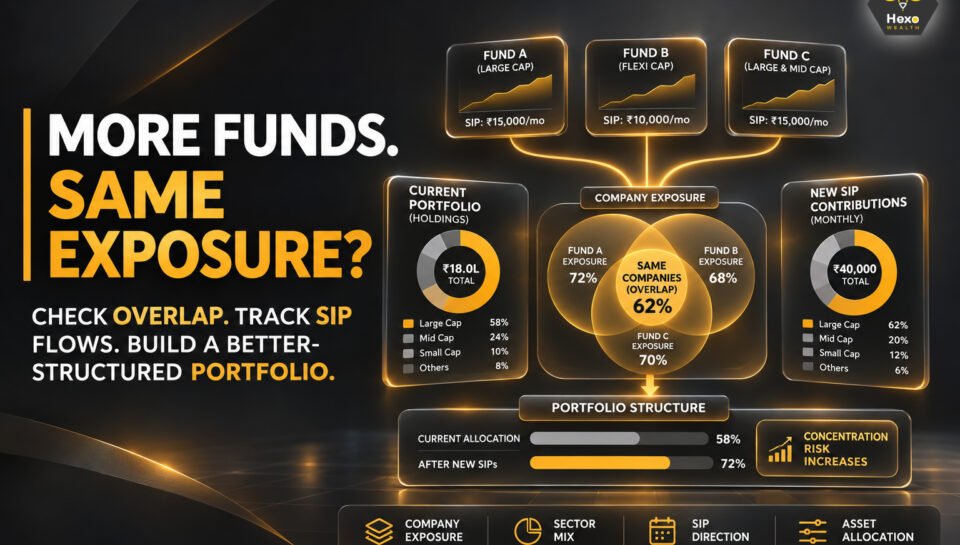
Mutual Fund Diversification: How to Identify Overlap and Build a Better-Structured Portfolio
An investor starts with two mutual funds, adds another after a salary increase and picks up a few more after comparing their historical returns. Five years later, the portfolio contains eight different schemes, but a significant portion of the money may still be invested in similar companies.
What makes this situation more interesting is that even a reasonably diversified portfolio today can gradually become concentrated if most new SIP contributions are directed towards similar investments.
Effective mutual fund diversification therefore requires looking at two things: where your accumulated money is currently invested and where your new money is going. Understanding both can help you evaluate whether your portfolio is becoming more diversified or simply becoming larger.
Why Holding Multiple Mutual Funds May Not Diversify Your Portfolio
Investors often assume that selecting funds from different categories or fund houses automatically provides diversification. However, schemes with different names and investment mandates can still have significant exposure to similar companies and sectors.
Consider an investor holding the following 4 schemes:
- A large-cap mutual fund
- A flexi-cap mutual fund
- A multi-cap mutual fund
- A Nifty 50 index fund
Although each scheme has a different investment mandate, all four may invest in some of the same large banking, technology and consumer goods companies.
The investor may believe that the money is spread across four distinct investment approaches. In reality, a substantial portion of the portfolio could depend on the performance of a relatively similar group of companies.
A diversified mutual fund portfolio should therefore be evaluated by its underlying investments, not simply by the number of schemes or fund houses represented.
Understanding Mutual Fund Portfolio Overlap
Mutual fund portfolio overlap occurs when two or more schemes hold common underlying securities. Funds may also have similar sector exposure, market-cap allocation or investment styles, even when their individual stock holdings differ.
Consider the following hypothetical holdings:
|
Company |
Fund A |
Fund B |
|
Company X |
8% |
6% |
|
Company Y |
7% |
5% |
|
Company Z |
4% |
3% |
|
Company W |
5% |
2% |
Both funds invest in the same four companies, but their allocation to each company differs. These four holdings alone contribute 16 percentage points of weighted overlap, calculated using the lower allocation to each common security.
However, fund-level overlap does not tell you everything about your personal portfolio.
Suppose you have invested ₹8 lakh in Fund A and ₹2 lakh in Fund B. Your combined exposure to Company X would be:
|
Investment |
Exposure to Company X |
|
Fund A: ₹8 lakh × 8% |
₹64,000 |
|
Fund B: ₹2 lakh × 6% |
₹12,000 |
|
Total exposure |
₹76,000 |
Although Company X represents 8% and 6% of the respective funds, it accounts for 7.6% of your combined ₹10 lakh investment.
This illustrates an important distinction: the overlap between two schemes depends on their underlying holdings, while your personal exposure also depends on how much money you have invested in each scheme.
Overlap is not automatically undesirable. Different funds may legitimately hold the same established companies while following distinct investment strategies. The concern arises when repeated exposure creates unintended concentration or when additional schemes fail to provide meaningful diversification.
How Diversification in Mutual Funds Should Be Evaluated
A useful diversification review examines four levels of investment exposure. Each reveals a different aspect of the portfolio that may not be visible from scheme names alone.
1. Company-Level Exposure:
Review the combined allocation to individual companies across your mutual fund holdings. A stock that appears among the top holdings of several schemes may represent a much larger share of your total portfolio than you realise.
The important measurement is not how many funds own the company, but how much of your total investment is ultimately exposed to it.
2. Sector Concentration:
Two funds may have relatively few common stocks but still invest heavily in the same industry. One may hold private-sector banks while another holds public-sector banks, financial services companies and insurance businesses.
The individual holdings are different, but both portfolios could be affected by similar economic and industry developments. Low stock overlap therefore does not necessarily mean low concentration risk.
3. Market-Capitalisation Exposure:
Holding large-cap, flexi-cap and multi-cap funds does not automatically establish how your investments are distributed across large, mid and small-cap companies.
Some schemes can hold substantial exposure to large companies despite having different category names. Reviewing their actual market-cap allocations provides a clearer picture of your combined equity exposure.
4. Asset Allocation:
A portfolio containing several equity mutual funds may be diversified across companies and sectors but still be heavily dependent on equity market performance.
Diversification within equity and diversification across asset classes are two different considerations. The relevance of equity, debt and other investment exposures depends on the investor’s financial goals, liquidity requirements, investment horizon and risk profile.
How to Diversify Mutual Fund Portfolio Without Adding Unnecessary Schemes
Improving portfolio structure does not necessarily require purchasing another mutual fund or redeeming an existing one. Sometimes, the most useful starting point is understanding how the current investments and ongoing contributions work together.
Step 1: List Your Existing Investments:
Bring all mutual fund investments into one consolidated view, including investments made through different platforms, distributors and AMCs.
For each scheme, record:
- Scheme name and category
- Current investment value
- Percentage of the total portfolio
- Monthly SIP contribution, if applicable
- Investment objective
- Financial goal and expected investment horizon
Recording both the current investment value and ongoing SIP amount is important because they reveal two different aspects of portfolio allocation.
Step 2: Understand the Role of Each Scheme:
Every scheme should have an identifiable purpose within the portfolio. That purpose could relate to its investment approach, asset-class exposure, market-cap allocation or connection to a particular financial goal.
If two schemes appear to serve the same purpose, examine whether their underlying portfolios and investment strategies are sufficiently different. Similar exposure may be intentional, but duplication without a clear reason can make the portfolio unnecessarily complicated.
Step 3: Check Holdings and Sector Overlap:
Compare the latest available portfolio disclosures of your mutual funds, preferably using data from the same reporting month. Examine common securities, combined sector allocations and the additional exposure created by each scheme.
In February 2026, new mutual fund categorisation requirements introduced a 50% portfolio overlap limit for specified comparisons involving sectoral and thematic equity schemes, with certain exceptions. Category-wise overlap disclosure requirements were also introduced.
However, this 50% regulatory limit should not be interpreted as a universal benchmark for an individual investor’s portfolio. An overlap figure above or below a particular percentage does not independently establish whether a scheme should be retained or redeemed.
Step 4: Align Investments With Financial Goals:
A portfolio can appear reasonably diversified today while its future contributions gradually change its structure.
Consider an illustrative investor with a ₹20 lakh mutual fund portfolio and ₹40,000 in monthly SIPs.
|
Investment exposure |
Current value |
Monthly SIP |
|
Equity mutual funds |
₹12 lakh |
₹40,000 |
|
Debt mutual funds |
₹8 lakh |
₹0 |
|
Total |
₹20 lakh |
₹40,000 |
The current equity-to-debt allocation is 60:40. However, 100% of the investor’s new contributions are directed towards equity.
Assuming no investment gains, losses or withdrawals, after twelve months the portfolio would look like this:
|
Asset class |
Current allocation |
After 12 months |
|
Equity |
60% |
67.7% |
|
Debt |
40% |
32.3% |
Without switching or redeeming a single mutual fund, the investor’s asset allocation has changed simply because of the direction of ongoing contributions.
Actual allocations will also be influenced by investment performance and changes in underlying holdings. The example nevertheless demonstrates why examining the current portfolio alone may provide an incomplete picture.
Your existing portfolio shows where your money is today. Your SIP allocation shows where your portfolio may be heading.
Both deserve attention when evaluating mutual fund portfolio diversification.
Step 5: Review Before Making Changes:
Identifying overlap or concentration does not automatically mean an existing scheme should be sold. The appropriate response depends on the investment objective, extent of concentration, financial goal, risk profile and potential transaction implications.
A review may identify different possibilities:
- Existing investments and SIP allocations remain appropriate.
- Future contributions require further evaluation.
- A particular scheme’s role needs closer examination.
- The overall portfolio structure deserves a more detailed review.
Any potential redemption or switch should also be evaluated for applicable taxation, exit loads and scheme-specific conditions. Reducing the number of mutual funds should not become the objective of diversification.
What a Mutual Fund Portfolio Review Can Reveal
Two investors may own exactly the same mutual fund schemes but have substantially different portfolio structures because their investment amounts and ongoing contributions differ.
A meaningful mutual fund portfolio review should therefore examine the investor’s actual allocation rather than relying entirely on scheme-to-scheme comparisons.
The Hexo Portfolio Contribution Check
Before adding another mutual fund, compare what the existing portfolio owns with what the additional scheme would contribute.
|
Review question |
What it reveals |
|
Where is my existing money invested? |
Current stock, sector and asset-class exposure |
|
Where are my monthly SIPs going? |
The direction of future portfolio allocation |
|
What would the new fund introduce? |
Additional exposure or potential duplication |
|
What risks would become more concentrated? |
Possible unintended changes in portfolio structure |
|
What financial goal would the new fund serve? |
Whether the additional investment has a meaningful purpose |
For example, an investor considering another large-cap fund may discover that their existing index, flexi-cap and multi-cap funds already provide substantial large-cap exposure. Adding another scheme could increase the amount invested without introducing a significantly different source of diversification.
The purpose of this check is not to establish an ideal number of funds. It is to understand what changes within the portfolio when additional money is invested.
Are You Investing in Different Mutual Funds but Holding Similar Investments?
A portfolio built over several years may contain schemes purchased for different reasons, through different platforms and at different stages of life. Individually, those investment decisions may have appeared reasonable, but their combined effect can be difficult to recognise.
Reviewing existing holdings alongside ongoing SIP allocations can reveal whether the portfolio continues to reflect its intended investment structure.
For investors looking for a Mutual Fund Distributor in Thane, Hexo Wealth Associates LLP provides mutual fund distribution and related investor servicing support, including discussions around existing mutual fund holdings, scheme characteristics, investment horizons and eligible mutual fund transactions.
Understanding what your existing investments collectively hold can be a useful starting point before considering additional schemes.
Hexo Wealth Associates LLP | AMFI-registered Mutual Fund Distributor | ARN 353817
Frequently Asked Questions
Disclaimer
This article is intended solely for general investor education and information. It does not constitute personalised investment, financial, tax or legal advice, or a recommendation to purchase, redeem, switch or hold any particular mutual fund scheme.
All portfolio examples, allocation percentages and calculations are hypothetical and illustrative. They should not be interpreted as recommended asset allocations, acceptable overlap thresholds or forecasts of future portfolio performance.