


Financial Planning for Business Owners: Align Investments With Your Goals
A business can have one of its best years and the owner can still be unsure how much money is actually available for the family’s future.
The profit number may look healthy. But some money is waiting to come from customers. Some needs to remain in the business for salaries, inventory, taxes or expansion. A home EMI continues every month. A child’s education is getting closer. Retirement is somewhere in the background.
Then, after a particularly good quarter, the owner sees a large bank balance and thinks: “Should I invest this money somewhere?”
That sounds like an investment question.
For a business owner, it is usually a much bigger question. Before deciding where the money should go, you first need to know whether that money genuinely belongs to the business, the family’s near-term needs or a long-term personal goal.
This is what makes Financial Planning for Business Owners different from simply choosing another investment product.
Your business may be your largest source of income and your biggest asset. But your family’s future should not automatically depend on every business assumption going exactly as planned.
Why Financial Planning Is Different for Business Owners
A salaried professional generally knows approximately how much money will arrive every month. For many business owners, that certainty does not exist.
One month may bring strong collections. Another may bring very little. A profitable year on the P&L can still create cash pressure because money remains stuck in receivables or inventory.
By the end of December 2025, more than 2.56 lakh delayed-payment applications filed by micro and small businesses involved over ₹55,244 crore. That tells us something important: money earned by a business and money actually available today are not always the same thing.
A business owner may also have money spread across:
- Business reserves
- Receivables
- Fixed deposits
- Personal bank savings
- Mutual funds
- SIPs
- Insurance
- Property
- Retirement investments
- Other family assets
That creates a unique financial tension.
The business needs capital to grow. The family needs capital to become financially independent of the business. Both are legitimate. The challenge is deciding where one ends and the other begins.
A business owner who invests every available rupee back into the company may build a valuable enterprise but very little personal liquidity.
Another owner may withdraw too much after a good year and leave the business short of working capital six months later.
The objective is not to choose one side. It is to create a sensible boundary between them.
Start With Your Financial Goals, Not an Investment Product
Many entrepreneurs begin with: “Where should I invest my money?” Try changing the question to: “What does this money need to achieve?”
That small change improves the entire decision.
Suppose a business owner has four priorities:
- Build an emergency reserve
- Fund a child’s higher education after eight years
- Purchase a larger home after five years
- Become financially ready to step away from the business at age sixty
These are four different jobs. They should not automatically be funded through one undefined investment portfolio. This is where Goal-Based Investing for Business Owners becomes useful.
A practical Financial Goal Planning exercise can ask:
- What is the goal?
- What would it cost today?
- What could it cost when the money is required?
- When will the money be required?
- What is already specifically allocated to it?
- How much can reasonably be added going forward?
- Is there a potential gap?
- How much investment fluctuation can be accepted for that goal?
If several goals are competing at the same time, the Hexo Life Goals Calculator can help put them into one view. You can estimate future costs after inflation, map existing goal-linked investments and understand where the assumptions indicate a possible gap or surplus.
The useful part is not getting one impressive future number.
It is making sure the same ₹10 lakh is not mentally being used for the child’s education, home purchase and retirement at the same time. Only after the goal becomes clearer should the investment product enter the discussion.
Investment Planning for Business Owners
Investment Planning for Business Owners has one complication that salaried investing often does not have.
The amount available to invest can change sharply from year to year.
A very profitable quarter may create a large temporary bank balance. But that does not automatically mean the entire amount is available for a fifteen-year investment.
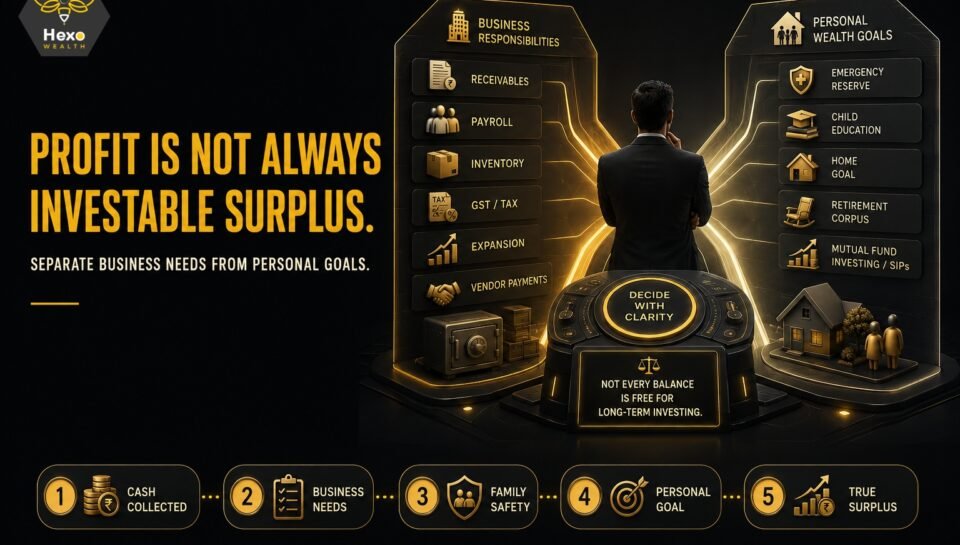
Before treating business-generated money as long-term personal surplus, use what we call the:
The Hexo Owner’s Investable Surplus Check
1. Has the Money Actually Been Collected?
There is a difference between:
- Revenue booked
- Profit reported
- Invoice raised
- Cash received
Personal investment decisions should not be built around money that is still expected from customers.
2. Could the Business Need This Money Again Soon?
Think about:
- Payroll
- Vendors
- GST and taxes
- Loan repayments
- Inventory
- Maintenance
- Working capital
- Planned expansion
- Seasonal requirements
A large bank balance immediately after collections can look like surplus even when upcoming obligations will consume much of it.
3. Is the Family’s Safety Money Separate?
A business emergency reserve and a family emergency reserve are not necessarily the same thing.
If the business enters a difficult period, the owner may need household savings precisely when the business also needs cash.
Using one pool for both can create pressure on both sides.
4. Which Personal Goal Is This Money For?
Once money has genuinely moved out of business requirements, give it a personal job.
Is it meant for:
- Retirement
- Education
- Home
- Long-term wealth
- Another family requirement
Without that clarity, a profitable year can simply create another random investment.
5. What Is Actually Left?
Only after the business requirements, near-term commitments and family safety needs have been considered do you get closer to the amount that can reasonably be evaluated for longer-term investing.
This distinction matters: Profit is not automatically investable surplus.
Short-Term Financial Requirements:
If money may be required in the near future, accessibility becomes important.
Perhaps a business owner expects to fund part of a property purchase two years from now. Or an amount may be required for a known family responsibility.
Money with a near-term job should not automatically take substantial market risk merely because the business owner is comfortable taking risk inside the business.
Business risk capacity and personal-goal risk capacity are not always the same.
Medium-Term Goals:
For a goal several years away, consider:
- Future requirement
- Existing investments
- Time available
- Ability to continue investing in weak business years
- Risk capacity
- Importance of the goal
A child’s education six or eight years away should not be treated simply as “long-term money” without thinking about when risk may need to reduce as the goal approaches.
Long-Term Goals:
A long horizon provides more time. But time alone does not make every investment suitable.
For long-term goals, the investment decision should still consider:
- Risk profile
- Existing portfolio
- Business concentration
- Other personal assets
- Ability to stay invested through weak business cycles
- Liquidity requirements
This prevents one investment product from being expected to solve every financial requirement.
Retirement Planning for Business Owners
For many entrepreneurs, the business quietly becomes the retirement plan.
The thought process is understandable: “Business achha hai. Retirement ke time sell karenge, ya income aati rahegi.”
That may happen. But it creates a major assumption. The business needs to:
- Remain profitable
- Remain valuable
- Find a buyer or successor if required
- Produce the expected sale value
- Do so around the time you want to step away
That is a lot of future conditions attached to one asset. This is why Retirement Planning for Business Owners becomes especially important.
The business can absolutely form part of the retirement picture.
But it is useful to calculate the personal retirement requirement without first assuming that the business will solve the entire gap.
Start with:
- Current household expenses
- Expected retirement age
- Years available
- Inflation
- Healthcare requirements
- Existing personal investments
- Expected retirement income
- Lifestyle requirements
- Assets already earmarked for retirement
Then separately consider what role the business may eventually play.
This creates a useful distinction: Business value is not the same as retirement liquidity.
A business may be worth several crores on paper, but until a succession, sale or income structure actually exists, that value cannot automatically pay monthly retirement expenses.
The Hexo Retirement Calculator can help estimate future retirement expenses, the corpus potentially required and how existing investments and contributions compare with that requirement.
This gives the business owner something more useful than: “Business bik jayega toh retirement ho jayega.”
It gives a separate retirement number to work towards.
Mutual Fund Investment for Business Owners
Mutual Fund Investment for Business Owners can form part of a personal investment portfolio when the chosen investment is suitable for the goal, risk profile and time horizon.
But business owners need to ask one extra question: Could I be forced to redeem this investment because my business needs money?
Suppose an entrepreneur invests a large lump sum into a market-linked investment after a strong year. Eight months later, two major customers delay payments and working capital becomes tight. If the only accessible source of money is the personal investment portfolio, the owner may need to redeem at exactly the wrong time.
That does not necessarily mean the mutual fund was unsuitable.
The problem may have happened before the investment was made because money required for business liquidity was treated as long-term personal surplus.
Before adding another mutual fund, ask:
- What goal does it support?
- When will the money be required?
- How much is already allocated to that goal?
- Can the money genuinely remain invested through a weaker business year?
- How much market fluctuation can you tolerate?
- Does the existing portfolio already have similar exposure?
- Is this personal capital or temporarily unused business capital?
A good investment used for the wrong pool of money can still create a bad outcome.
How SIPs Can Fit Into an Entrepreneur’s Investment Plan
SIPs can help create regular investing discipline. But entrepreneurs do not always have regular income. This makes SIP Investment for Entrepreneurs slightly different from simply selecting a percentage of monthly salary.
One practical question is: What amount could I comfortably continue even during an ordinary or weaker business period?
That may be more useful than setting the SIP according to the best month of the year.
Suppose one year produces exceptional profits and the next year requires more working capital.
An unnecessarily aggressive fixed commitment may become uncomfortable.
A more sustainable approach is to connect regular investing with the personal goal and realistic household cash flow. Then, when genuinely surplus money becomes available after business obligations are accounted for, additional investment can be evaluated separately.
The objective is not to maximise the number of SIPs. It is to build a contribution pattern that has a reasonable chance of surviving both strong and weak business years.
Review Existing Investments Before Adding More
Business owners often accumulate investments gradually.
One fund was bought for tax saving. Another after a good business year. A SIP was started after a conversation with a friend. An FD matured and was renewed. Property was purchased because it felt familiar. Years later, the personal portfolio may be sizeable but difficult to explain.
An Investment Portfolio Review can help answer:
- What mutual funds do I currently own?
- Which goals are they connected to?
- What SIPs are active?
- What fixed deposits and other assets exist?
- What is the overall asset allocation?
- Is too much personal wealth exposed to the same economic risks as the business?
- Are there overlapping mutual funds?
- Which investments have no clear job?
- Is retirement too dependent on the eventual value of the business?
A Mutual Fund Portfolio Review does not automatically mean changing funds.
Sometimes the right conclusion is: “This investment still does exactly what it was meant to do.”
Knowing that is valuable too.
Tax-Saving Investments Should Support the Plan
Tax often becomes an unusually powerful investment trigger for business owners.
As the financial year moves towards its end, the conversation can quickly become: “Tax bachane ke liye kahan invest karein?”
And that is understandable. No one wants to pay more tax than they are legally required to. The problem begins when saving tax becomes the only reason for choosing an investment.
At Hexo, we think about this through a simple philosophy called TAXTICS. The idea is simple: Make smart tax moves instead of random last-minute investment decisions.
A tax-saving decision should ideally do more than reduce this year’s tax liability. It should also make sense for the role that money needs to perform in your larger financial life.
For example, Tax-Saving Mutual Funds may come into consideration for eligible investors depending on their tax regime and individual circumstances. But before investing only because a deduction may be available, look at the complete decision.
Ask yourself:
- Am I actually eligible for the deduction under the tax regime applicable to me?
- Would I still consider this investment if there were no immediate tax benefit?
- What financial goal is this money meant to support?
- Does the investment horizon match when I may need the money?
- Am I comfortable with the investment risk involved?
- Do I already have another investment serving the same purpose?
- Am I choosing this because it fits my situation, or simply because the financial year is ending?
This is where TAXTICS becomes useful. The objective is not: Tax first. Investment later.
It is: Understand the tax implication, understand the investment, and make sure both fit the same financial decision.
A tax benefit can improve an already suitable investment decision. It should not be the reason an unsuitable investment enters your portfolio.
For business owners, this becomes even more important because the applicable tax regime, business income and deduction eligibility can differ based on individual circumstances. Tax-regime selection and business-specific tax implications should therefore be checked with a qualified tax professional.
Good TAXTICS should help you save tax intelligently without losing sight of why the money is being invested in the first place.
A Practical Example for a Business Owner
Consider a 42-year-old business owner. The business has had a strong year. There is ₹35 lakh that appears available across business and personal accounts.
The owner has three priorities:
- Child’s higher education in eight years
- Retirement at sixty
- Business expansion planned within the next eighteen months
The easy decision would be: “₹35 lakh available hai. Invest kar dete hain.”
Now apply the Owner’s Investable Surplus Check.
First, ₹12 lakh may actually be required for expansion. Another amount needs to remain available for vendor, tax and working-capital requirements. The family emergency reserve also needs strengthening.
Once these amounts are separated, perhaps only part of the original ₹35 lakh is genuinely available for long-term personal goals.
Now look at the personal goals.
Existing investments may already fund part of the education requirement. Retirement may have a much larger projected gap because most of the owner’s net worth is currently tied to the business.
The next investment decision now looks completely different.
Nothing about the investment market changed. The clarity about the money changed.
This is the difference between simply investing available money and understanding which money is actually available for investment.
Financial Planning Checklist for Business Owners
Used as an educational exercise, a Financial Planning Checklist for Business Owners should bring both sides of the owner’s financial life into view.
Before making another personal investment, review:
Business Side:
- Current cash position
- Receivables
- Known vendor payments
- Tax obligations
- Loan repayments
- Working-capital requirement
- Planned capital expenditure
- Expansion commitments
Personal Side:
- Household expenses
- Family emergency reserve
- Insurance protection
- Existing liabilities
- Short-term personal requirements
- Children’s education
- Retirement requirement
- Existing savings
- Mutual funds and SIPs
- Other personal assets
Investment Side:
- Goal
- Future requirement
- Time horizon
- Existing goal-linked investments
- Risk profile
- Potential funding gap
- Whether the money can genuinely remain invested
This is much more useful than deciding what to invest in simply because a large amount is temporarily visible in the bank account.
Financial Planning for Entrepreneurs: Keep Business and Personal Goals Connected
There is a subtle difference between connected and dependent.
Your personal financial life will naturally remain connected to your business. The business creates income. It may eventually create significant wealth. It may also be an important family asset. But your family’s entire future does not need to remain dependent on the business performing perfectly forever.
A useful question for Financial Planning for Entrepreneurs in an educational context is: If the business stopped sending money home for one year, which personal goals could still continue without disruption?
- Could the home EMI continue?
- Could the child’s education still be funded?
- Would health insurance remain in place?
- Would retirement investing stop immediately?
- Would every personal investment need to be redeemed?
The stronger the personal side becomes, the less pressure every difficult business year places on the family. And interestingly, that can also help the entrepreneur.
When every family goal is dependent on the next business cash flow, business decisions can become personal very quickly.
Building personal financial assets outside the business can gradually create another kind of wealth: the ability to make business decisions without every family requirement sitting on the same balance sheet.
Your business can remain your biggest wealth creator. It does not have to remain your only source of personal financial security.
How Hexo Wealth Can Help
For business owners whose personal portfolios include mutual funds, the first useful step is often understanding what already exists before adding more.
Within its role as an AMFI-registered Mutual Fund Distributor, we can support investors with:
- Reviewing existing mutual fund holdings
- Understanding the stated goal and investment horizon behind the portfolio
- Identifying unnecessary mutual-fund overlap
- Evaluating mutual fund options based on stated goals, time horizon and risk profile
- Facilitating eligible mutual fund transactions
- Supporting SIP execution and ongoing mutual fund servicing
We do not begin from: “Which new fund should you buy?”
The more useful starting point is: “What job is this money supposed to perform, and is it genuinely personal investable money?”
Hexo Wealth Associates LLP is an AMFI-registered Mutual Fund Distributor in Hiranandani Estate, Thane.
ARN: 353817
Frequently Asked Questions:
Business owners can have variable cash flow, significant wealth tied to the business, working-capital requirements and multiple personal goals. Looking at these requirements together can help distinguish business money from personal money and clarify what can genuinely be allocated towards longer-term personal goals.
Begin by identifying the goal and separating business requirements from personal investable surplus. Then estimate the future requirement, review existing goal-linked investments and identify any potential gap before evaluating additional investments.
Mutual funds may be considered where the investment is suitable for the individual’s goal, investment horizon, risk profile and financial circumstances. Money required for near-term business operations should not automatically be treated as long-term personal investment capital.
A business may be an important part of the owner’s wealth, but personal investments can reduce dependence on one asset and help fund goals that should not rely entirely on the future value or sale of the business.
They can be considered where regular investing fits the investor’s goal and cash-flow situation. A sustainable contribution based on realistic personal cash flow may be more practical than setting the amount according to an unusually strong business month.
Build Personal Wealth Without Losing Sight of the Business
Business owners spend years learning how to allocate capital inside the business.
- Which machine to buy.
- Which employee to hire.
- How much inventory to carry.
- Whether to expand.
- Where to reduce costs.
Personal money deserves the same clarity. Not every profitable rupee needs to be invested. Not every available rupee belongs to the business. And not every future goal should depend on the eventual value of the company.
The useful sequence is:
- Separate what the business needs.
- Protect what the family needs.
- Define what each personal goal requires.
- Review what is already available.
- Then evaluate where genuine long-term surplus should go.
Your business may create your wealth. Your personal portfolio can help make sure your family’s future is not dependent on only one asset, one income source or one eventual business outcome.
Looking to Organise Your Mutual Fund Investments Around Your Personal Goals?
If you have accumulated mutual funds and SIPs over different stages of your business journey, Hexo Wealth can help you understand those investments in the context of your stated goals, investment horizon and risk profile.
Hexo Wealth Associates LLP is an AMFI-registered Mutual Fund Distributor in Hiranandani Estate, Thane.
ARN: 353817
Disclaimer
This article is intended solely for investor education and general information. It should not be treated as investment advice, business advice, tax advice, legal advice, detailed financial planning or as a recommendation to invest in any particular mutual fund scheme, security or financial product.
Terms such as Financial Planning for Business Owners, Financial Planning for Entrepreneurs, Financial Goal Planning, Investment Planning for Business Owners and Retirement Planning for Business Owners are used in an educational and search-context sense in this article and should not be interpreted as representing Hexo Wealth as a SEBI-registered Investment Adviser or provider of comprehensive financial-planning services.
Business cash-flow requirements, tax treatment and investment suitability vary by individual circumstances. Business owners should obtain appropriate professional accounting, tax or legal advice where required.
Hexo Wealth Associates LLP is an AMFI-registered Mutual Fund Distributor, ARN 353817, and may receive commissions from Asset Management Companies on investments made under Regular Plans.
Mutual Fund investments are subject to market risks, read all scheme related documents carefully.